
On the state of scholarship in the American academy, and on the state of humanity
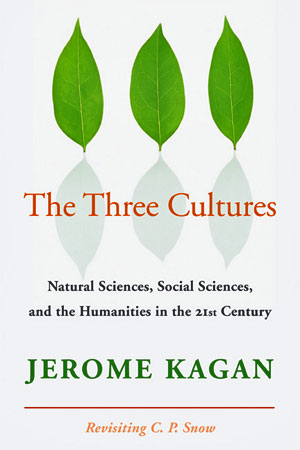
Jerome Kagan on his book The Three Cultures: Natural Sciences, Social Sciences, and the Humanities in the 21st Century
In a nutshell
The Three Cultures compares the premises, vocabulary, sources of evidence, contributions, and limitations of the research, scholarship, and theories of natural scientists, social scientists, and humanists. The concepts of physicists, chemists, and biologists refer to things with material features, such as particles, molecules, cells, and neurons. Most social scientists and humanists rely on concepts for events, such as behavior, thought, and emotion, that occur at the end of a cascade of processes that originated in a material brain, but require a special vocabulary that cannot be replaced with biological terms.
One group of social scientists avoids phenomena and explanations that have any ethical component. These scholars typically study sensory and perceptual phenomena, some aspects of memory, and motor skills and often try to find correlations of these events with activity in brain circuits. The larger group, more interested in human variation and adaptation to the local society, finds it hard avoiding an ethical preference—the judgment that a person is or is not psychologically adjusted usually requires an evaluation of the qualities that are better or worse than others with respect to some ethical ideal. Furthermore, these scholars rely heavily on words as the primary source of evidence because they frequently use questionnaires and interviews. This practice poses serious problems because words and sentences have unique properties that are not possessed by behaviors, mental images, or private feelings.
Scholars in the humanities have most specific missions. One group tries to detect an important change in the ideology of a society or in the meanings of popular concepts and communicates this information to a public that has not yet recognized these new ideas. Others are primarily motivated to generate an aesthetic response in their audiences. Unlike natural and social scientists, humanists cannot perform experiments that can evaluate the validity of their insights. Only the roll of history can perform this judgment.
The contributions of the natural sciences, which include better health, longevity, and labor-saving devices, have persuaded the public and the media that natural scientists are entitled to a special status and that judicial, legislative, and even some personal decisions, should be based on factual evidence affirmed by the studies of these intellectuals. This view is seriously flawed. Biologists have established beyond doubt that all male primates, including humans, are naturally sexually promiscuous. But few communities are ready to remove moral and legal sanctions on a man who impregnates a woman who is not his legal spouse. That decision rests on a moral belief – and it is not foolish though it flouts the scientific facts.
The dominant premise in evolution and economics is that a person is being loyal to natural law if he or she attends to self’s interest and welfare before being concerned with the needs and demands of family or community. The public does not realize that this statement is not an established scientific principle but an ethical preference. Nonetheless, this belief has created a moral confusion among North Americans and Europeans because the evolution of our species was accompanied by the disposition to worry about kin and the collectives to which one belongs.
The wide angle
The birth of this manuscript was the need for a summer writing project married to the accidental spotting of C. P. Snow’s Two Cultures near the shelf where I was searching for a book in Harvard’s Widener Library. After reading Snow’s 1959 essay the following weekend, it became clear that revisiting Snow’s thesis 50 years later allowed me to organize my thoughts about the state of scholarship in the American academy and to synthesize my unhappiness with the dramatic ascent of the natural sciences in the years following World War 2, which intimidated the other two scholarly communities.
A deep theme in The Three Cultures centers on the different meanings of truth; that is, what does an individual point to when he or she declares, “I believe that idea to be true.” The correspondence between a statement and a reliable observation is the usual meaning of truth for both scientists and the public. However, mathematicians and some physicists accept the logical consistency of a mathematical argument as a second, different definition. The physicists who call themselves string theorists believe that their equations are true, even though many phenomena assumed by the equations have never been observed.
Many humanists accept the semantic coherence of a text and its correspondence with the readers’ intuitions as a related, but distinctive, definition. Readers of John Rawls’s Theory of Justice or Richard Dawkins’s book on selfish genes regard the texts as capturing the truth, even though many statements lack correspondence with observations and do not use formal arguments. William Styron’s Sophie’s Choice, Dostoevsky’s Crime and Punishment, and Tennessee Williams’s Camino Real have the ring of truth for those whose semantic networks are in accord with those of the authors.
The related concept of “ethically right” belongs to another meaning network that shares the semantic node correct with the concept true. All who are certain that no human should harm or torture an innocent are convinced of the correctness of this belief which, unlike truth, involves a contrast between good and bad.
The final chapter of The Three Cultures is penetrated with personal ethical evaluations of the changes in the ambience of the research university, including the epidemic of a naked seeking of celebrity, the erosion of faculty loyalty to the university or the student body, the surrender by both administration and faculty to the seduction of political correctness, and the faculty acquiescence to demands to account for their time, to publish enough papers to announce that they possess a work ethic and, if possible, to bring overhead money to the college treasurer. Alfred North Whitehead, Max Planck, Niels Bohr, Rita Levi-Montalcini, and Marie Curie would have been puzzled by this new breed of academic scholar.
The dominant premise in evolution and economics is that a person is being loyal to natural law if he or she attends to self’s interest and welfare before being concerned with the needs and demands of family or community. The public does not realize that this statement is not an established scientific principle but an ethical preference.