
Dana Nelson
Bad for Democracy
The first and biggest part of my book is about how we take the president for granted as the symbolic, cultural and institutional center of democracy, and how we take voting for the president to be the essence of democracy—and why those two commonsense assumptions about how our political system works are actually bad for democracy.
My book argues that our habit of putting the president at the center of democracy and asking him to be its superhero works to deskill us for the work of democracy. And, it argues that the presidency itself has actually come to work against democracy—against the sovereignty of the People upon which our Constitution’s authority rests. Bad for Democracy tells the story of how this came to be—how the symbolism developed and took root, how the institution developed and began accumulating more and more power, and how, under the new theory of the Unitary Executive, proponents are actually waging a war against democracy, in the name of “democracy.”
The conclusion outlines my ideas for how we can turn back this 200+ year historical trend, and take democracy back, by the People, for the People. I want us to rethink democracy along the lines of an open system. Wikis and time banks are both good conceptual models and tools for this project. In this way of building democracy, our representative government is just one part of the project—it’s the formal institutions that create and administrate the laws and policies we all abide by.
We can find creative ways to have far more wide-ranging and substantive input into those processes, and we can find a far broader range of non-governmental activities that can benefit from democratic deliberation, input and action. I think if we start creatively working, both formally and informally, to make democracy something more broadly participatory and wide reaching, we can build a political system around, on top of, and into our current formal representative government that we find more rewarding, more representative, more engaging, and more satisfying.
Editor: Erind Pajo
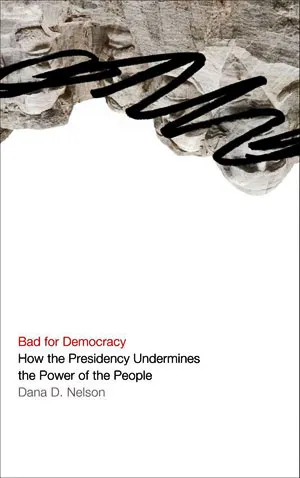
Bad for Democracy
Dana Nelson Bad for Democracy: How the Presidency Undermines the Power of the People University of Minnesota Press 256 pages, 6 x 9 inches ISBN: 978 0 8166 5677 6
Available here →December 23, 2008
20081223-nelson-dana-bad-for-democracy-how-presidency-undermines-power-peop-1-1
In a nutshell
The rest of this thread

Daniel Dubois © Vanderbilt University
Dana Nelson
Dana D. Nelson is a professor of English and American studies at Vanderbilt University where she teaches classes in U.S. literature, history and culture, and courses that connect activism, volunteering, and citizenship. She has published numerous books, essay collections and articles on U.S. literature and the history of citizenship and democratic culture. Nelson lives in Nashville where she is involved in a program that helps incarcerated women develop better decision-making skills, and works for an innovative activist group fighting homelessness in the area.
Pull this thread
pulls againstpulls alongside
Treating the presidential vote as the essence of democracy deskills citizens and strengthens the office whoever holds it.
Nearby GJ · The president is the prime author of his party's brand, and the causal arrow runs from president to party.
Nearby DR · Between the mid-1970s and 2001 the words Americans used to grasp society broke into smaller pieces.
Nearby JA · Obama won in 2008 by becoming a collective representation, not through demographics, money or organization.
Know something the rest of us don't?
Most threads on Rorotoko begin with our invitation. Any thread can begin with a proposal: you write it with the same prompts every thread answers, and we review it.
Propose a thread →