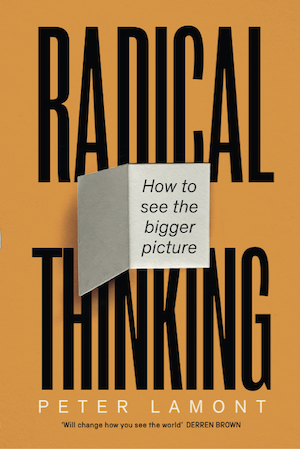
Radical Thinking is a book about how we make sense of the world, and how we can make more sense of it. But it’s not a typical ‘critical thinking’ book. It’s ‘radical’ (from the Latin radic, meaning ‘root’) because it’s about the roots - the foundations - of what we think. In other words, it’s about the things that shape our thoughts.
For example, here are two of them. Whatever we think, about anything at all, depends on what we notice. However, we notice a fraction of what’s going on. And, whatever we notice, we need to interpret it. However, we always interpret it in a particular way. People notice different things and interpret them in different ways. So, we end up with different beliefs. What we believe also depends on what we assume, what we find convincing, how we feel and what we want.
The book is also very different in the way that it covers these topics. It’s based on the assumption that, to make more sense of the world, we need to be more curious about how we look at it. And, since we can only look at the world from where we are, I use my location (Edinburgh) as a way to explore how we think about everything. I talk about curious local things (such as the inspiration for Sherlock Holmes, the birth of Encyclopaedia Britannica and the original self-help book) to explain the things that shape our thoughts. It goes without saying, though I’ll say it anyway, that you don’t need to know anything about Edinburgh.
The wide angle
The book actually began as a ‘critical thinking’ course at the University of Edinburgh. However, having done research on the history of ‘critical thinking’, I took a different approach to the topic.
Basically, what happened in the twentieth century is that ‘critical thinking’ became increasingly about getting it right. It did this by focussing on the logical fallacies that we make, and on the biases that we have, which lead us to get it wrong. I didn’t want to do that because I don’t think that’s the best approach. After all, if we want to make sense of what people say in the real world – outside the philosophy classroom - logic only gets us so far. And, while we all have biases, how can we know when they lead us to get it wrong? We would need to know the truth. But that’s often what we’re arguing about. The result is what we see all the time. People disagree about what’s true and accuse each other of bias.
So, in the course, rather than focus on getting it right, I focused on what, I think, critical thinking should be: thinking about the process, not the outcome, of our thoughts. In other words, whatever you think, it’s not about where you end up. It’s about how you get there. We often end up in different places, but we get there through a similar process. It always depends on what we notice, on how we interpret it, and so on. And since, to make more sense of the world, we need to be more curious about how we see the world, I used intriguing stuff - quirky history, stories and even magic tricks - to get students curious about how we make sense of the world.
As you might imagine, the course was very popular, but that was in late 2019. Then COVID happened and I couldn’t teach the course. That’s when I decided to turn it into a book.