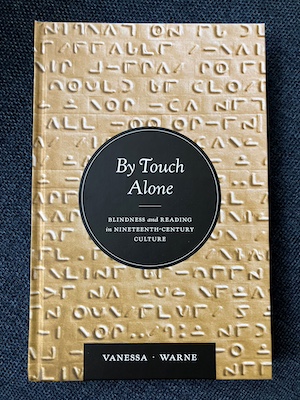
Vanessa Warne By Touch Alone: Blindness and Reading in Nineteenth-Century Culture University of Michigan Press 218 pages, 6 x 9 inches ISBN 978-0472057511
In a nutshell
By Touch Alone explores the experiences of the first generations of blind people who learned to read by touch. Exploring the reading lives of English-speaking blind people and the material history of the raised-print books they read, it documents the many ways in which reading by touch shaped nineteenth-century culture. While reading by touch transformed the lives of many blind people, changing their experiences of education, leisure, faith, social connection, and privacy, reading by touch also had impacts on nonblind people. Sighted observers of this new way of reading were, for example, prompted by the entry into literacy of blind people to reevaluate not only their beliefs about blindness but also their understanding of what it means to read.
To put this differently, the advent of reading by touch challenged existing ideas about the relationship between books and the bodies of their readers. Books made for and by the first generations of blind readers broke with many long-established conventions of book design. In addition to replacing inked text with embossed text, these books were differentiated from the books of the sighted majority by their dimensions and bulk, by the arrangement of text on the page, and by their experimentation with script systems different from the Roman alphabet.
As I explore in my book, by the middle of the nineteenth century, more than twenty different script systems had been proposed for use in books for blind readers. Braille, the now near-universal script used by blind readers, only secured its present-day prominence by outlasting many rival scripts. Now obsolete, some of these rivals to Braille were based on the shapes of shorthand symbols, some were radically simplified versions of the Roman alphabet, while others rejected orthographic conventions. One raised-print script, invented by British blind person William Moon, broke from the traditional ordering of letters and words in written English. Preferring the boustrophedonic arrangement of words and the letters they contain, Moon published books that alternated line by line between a flow of text from left to right and a flow of text from right to left. Readers would move their fingers left to right across the first line of text and from right to left across the second line. To a sighted reader, the word “the” in the first line of text would appear as “eht” when it appeared in the second line of text.
This experiment was one of many changes activists and innovators proposed with the goal of improving blind people’s reading lives. Like other changes, Moon’s arrangement of text challenged sighted people’s perception of their own reading practices as natural or superior. Perhaps unsurprisingly, some sighted commentators objected to innovations of this kind on the basis that they isolated blind and sighted people by differentiating the two groups’ written cultures. Some sighted commentators were so troubled by innovations of this kind that they described raised-print scripts as barbaric, foreign, and coded.

The wide angle
To explore blind people’s experiences of reading in nineteenth-century Britain and America and to better understand sighted people’s reception of the advent of raised-print books, I draw on a wide range of sources. They include firsthand accounts of reading by touch; press reports about the new schools where reading by touch was taught; poems, short stories, and novels that feature scenes of blind people reading; and works of visual art, such as paintings, that depict blind readers. I consider how the public display of blind people’s literacy, in city streets and on bridges, where some blind people read for money, shaped attitudes toward raised-print culture. I take up the ways in which reading by touch transformed blind people’s experiences in museums and art galleries.
I explore the work of numerous blind authors, including the poet Edmund White, essayist W.W. Fenn, and novelist Alice King. I explore, among other topics, how reading by touch shaped blind authors’ relationships with sighted amanuenses. I also explore how the published writing of sighted authors of the era, such as George Eliot, Rudyard Kipling, and Wilkie Collins, engaged experiences of reading by touch. I argue that the entry into literacy of blind people prompted many people to rethink the information-gathering potential of touch and to question Western culture’s perception of touch as a pleasurable but unrefined sense.
A close-up
By Touch Alone is a book about both the history of disability and the history of books. While my current research is guided by the insights of Critical Disability Studies, I began my academic career researching the history of books, specifically Victorian literary annuals. These ornamental books, also known as keepsakes, were designed for gifting and drawing-room display. They paired poetry and short prose pieces with engraved illustrations. Many of these literary pieces were written in response to the visual content of these books, typically images of picturesque landscapes and reproductions of portraits of aristocratic women. Catering to visual appetites and celebrating visual pleasures, literary annuals, like coffee-table books today, were books for looking at more than they were books for reading. And not unlike literary annuals, my early work on Victorian-era book history was visually oriented: it was about the look of books, about owners’ experiences looking at books, and about the visual experiences of literary contributors.
It was a volunteer position that shifted my research on nineteenth-century books away from the visual. Working alongside other volunteers, I recorded audiobooks for clients of the Canadian Institute for the Blind (CNIB), creating recordings of all sorts of materials, from novels to textbooks to food magazines. The office where we volunteered housed shelves of audio recordings in many different formats, some of them quite dated. It also housed a collection of braille publications. Surrounded by these materials, I realized how little I knew about the history of blind people’s access to written culture.
I felt, as a Victorianist, that I should know far more than I did about when blind people began to make use of what we now think of as audiobooks. I wondered especially about the historical relationship between audiobooks and braille books. Was there a time when these formats were perceived as rivals? Was the investment by organizations such as the CNIB in audiobook production changing present-day blind readers’ relationship or access to braille books? How did blind readers feel about the proliferation of audio material and the redirection of resources away from the publication of braille materials toward audio recordings? Reading By Touch explores the nineteenth-century history of reading by touch, but my work on it began with questions I had about our own moment.
Soon after the CNIB recording studio in my city closed, I was able to visit important archives and collections, including those of the UK’s Royal National Institute for the Blind, the Perkins School for the Blind, and the American Printing House for the Blind. I realized that, at that time, very little work had been done on the material history of the raised-print books made for and, importantly, by blind people in Victorian Britain. I decided to explore the design and proliferation of raised-print books, and also their reception by both blind people and sighted commentators. I wanted to know how reading by touch changed nineteenth-century blind people’s daily lives, but also how reading by touch changed the ways people thought about blindness, about books, and about both sensory and cognitive dimensions of the act of reading.
I was also able to learn from other scholars who were working on the nineteenth-century literary history of blindness, such as Dr. Heather Tilley, and from experts on the concept of blindness gain, such as Dr. Hannah Thompson. Blindness gain, the perception of blindness as enriching and beneficial to human experience, has been invaluable to my book’s analysis of the experiences of nineteenth-century blind people, many of whom felt that reading by touch made them more attentive, careful, and informed readers than their sighted contemporaries.
Lastly
I am grateful to all the people who supported the research I did for this book. I am especially grateful to the Victorian-era people who left us a rich body of materials to explore and learn from. I feel very fortunate to have this book published by the University of Michigan Press. Their ‘Corporealities: Discourses of Disability’ series played a central role in my education in Disability Studies and I’m very proud to have my book be a part of it. I would add that I’m thrilled that the book is available in open access and in a screen-reader-friendly format.
Now that By Touch Alone is out in the world, I hope it will encourage readers to think more about how the ability to read or the inability to read features in the development and persistence of negative stereotypes about people with disabilities, whether sensory or cognitive. I hope the book might shift some sighted readers’ attitudes toward blindness and blind people. Negative stereotypes about blind people, like the perception of blindness as tragic or calamitous, are very tenacious. I hope a better knowledge of the history of blindness and the lived experiences of blind people will pose an effective challenge to long-held negative beliefs.
In the case of the blind community, I hope the book adds in meaningful ways to historical knowledge about the experiences of the first generations of English-speaking blind people who designed, made, and read raised-print books. I think it’s fair to say that our own moment has much in common with the nineteenth century in the sense that blind people’s reading lives continue to be shaped by innovation, activism, and debate. Re-engaging the entry into literacy of blind people will, I hope, offer valuable context for discussions about the increasing digitization of blind people’s access to text. I hope that the experiences and insights of the first communities of people to learn to read by touch might offer guidance now, two centuries later, as blind readers make choices about what they value, what they want, and the role of touch and raised-print text in their reading lives.
.jpg)