
M. Gigi Durham
The Lolita Effect
The Lolita Effect promises girls that they can experience joyful sexuality and femininity, but only at a price: the price of conforming to the restrictive ideals it imposes on the entire landscape of female sexuality. So if a girl is not slender-yet-voluptuous, if she is “too” dark-skinned or light-skinned or freckled or birthmarked, if she is modest about flaunting her body, if she has a physical or mental disability, if she doesn’t strive to measure up to the imaginary standards of the imaginary male gaze, if she is concerned about violence in her life, if she thinks sex is not a commodity to be traded, bought and sold … then she’s out of luck, as far as the Lolita Effect is concerned.
The Lolita Effect is not an affirmation or celebration of girls’ sexuality, in all its diverse and blossoming forms. On the contrary, it is a restrictive, hidebound, market-driven set of impositions on girls’ sexuality. And it’s virtually inescapable, because it’s the only definition of girls’ sexuality that’s represented in the globally circulating mainstream media.
The feelgood the Lolita Effect promises is a consumer fantasy, and it’s designed to be short-lived, because the Lolita Effect needs to fuel constant consumerism in order to support the interconnected web of industries, from diet aids to pornography, that depend on it. So any sense of genuine, self-loving, unfettered sexual pleasure is inimical to it. It needs girls (and later, women) to feel the anxieties it generates about sex enough to spend exorbitant amounts of money in its pursuit. But it offers a façade of sexual empowerment that is a powerful lure. The Lolita Effect is a sexual Venus’ Flytrap, seducing unwary victims with promises of nectar, then devouring them.
The Lolita Effect has toxic side-effects that are manifested in girls’ everyday lives. From eating disorders and body image issues to dating violence, teen pregnancy, sexual abuse and sexual exploitation, girls everywhere grapple with the fallout from the Lolita Effect. For some girls, the side-effects aren’t significant. They can move past them and experience fulfilled, potent girlhoods and adult lives. But for others, the impacts are significant, long-term and devastating. The Lolita Effect operates on a continuum, affecting some girls much more negatively and brutally than others.
But no girl is immune to it.
By maintaining that sex and desirability are the prerogatives only of girls who conform to the restricted criteria of the Lolita Effect, a whole range of possibilities and potential joys are being implicitly denied to millions of others. And even for those who come close to meeting the Lolita Effect’s grueling criteria, the stress of measuring up surely makes it hard to enjoy a relaxed, pleasurable sexual experience. Even as it dominates, the Lolita Effect is actually antithetical to girls’ sexual fulfillment.
The Lolita Effect is intended to start a national conversation about girls’ sexuality, the media, consumerism, and culture. It’s intended to galvanize activism on behalf of our girls — activism against sexual exploitation of every kind, from mainstream media objectification to the harsh realities of child sex trafficking and child pornography. In a media-saturated environment, the book advocates for media literacy as a required part of the K-12 curriculum.
The media define girls as one-dimensional creatures whose sole attribute is sexuality; my book celebrates girls as multi-dimensional beings with a great deal to offer. Girls are intelligent, creative, artistic, athletic, spiritual, community-spirited, and powerful. They need to be recognized as complex individuals whose value far exceeds sexuality. The response to the book has been heartening. Along with being reviewed in a variety of mainstream outlets, from People magazine to The Washington Post, it has generated reader response that indicates it is striking a chord in contemporary society. For me, the notion of praxis – linking theory to real-world activism, practice, and social change – is a vital part of my scholarly commitment. The Lolita Effect is effecting that crucial connection.
Editor: Erind Pajo
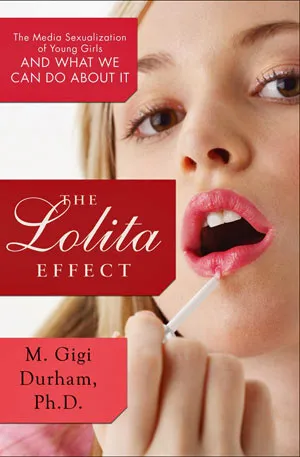
The Lolita Effect
M. Gigi Durham The Lolita Effect: The Media Sexualization of Young Girls and What We Can Do about It Overlook Press 304 pages, 6 x 9 inches ISBN: 978 1 59020 063 6
Available here →December 2, 2008
20081205-durham-meenakshi-gigi-lolita-effect-media-sexualization-young-girl-3
A close-up
The rest of this thread

Lifetouch Portrait Studios
M. Gigi Durham
Dr. Meenakshi Gigi Durham is an associate professor in the University of Iowa’s School of Journalism & Mass Communication. She has authored numerous articles on gender and sexuality in the media, especially regarding youth culture, for leading academic journals such as Critical Studies in Media Communication, Communication Theory, and Women’s Studies in Communication.
Pull this thread
The commercial sexualization of girls is a market product, separable from the age-appropriate sexual development it displaces.
Know something the rest of us don't?
Most threads on Rorotoko begin with our invitation. Any thread can begin with a proposal: you write it with the same prompts every thread answers, and we review it.
Propose a thread →