
Kieran Egan
The Future of Education
The beginning of Chapter 3 begins to lay out a different way in which we can conceive of how students learn to make sense of the world and their experience, and then the rest of the chapter explores five kinds of understanding that we accumulate by learning to deploy sets of “cognitive tools.” These yield what I call somatic, mythic, romantic, philosophic, and ironic forms of understanding. That’s the total of the book’s jargon. But these odd categories provide a new way of looking at how our minds can develop and find the world, as is only proper, emotionally and imaginatively engaging.
The aim of the book is to persuade people that the school as we know it is both an ineffective institution and also a doomed institution. What is offered is a kind of recipe for rescuing what is good about the idea of education and showing how we can rebuild schools that will be much more successful in educating children. I hope the book will stimulate people to reflect on the school in a more radical way than is common—what is common is the search for scapegoats for inadequacies, or the suggestion that some particular innovation cure will fix them. To read most books about education, you would get the idea that some particular reform—more attention to “the basics,” more freedom for children’s exploration, voucher systems and market disciplines, greater use of technology, and so on—would make the school work satisfactorily. I show that the problem with our modern idea of the school is not fixable by the array of remedies currently on offer. The problem lies elsewhere, and fixing it requires of us the tougher task of rethinking the idea of education.
Editor: Erind Pajo
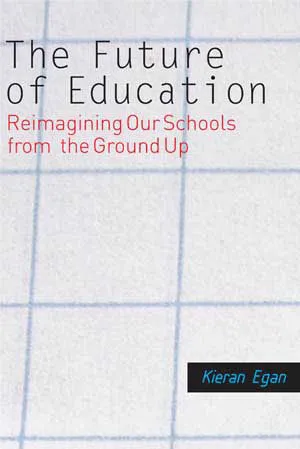
The Future of Education
Kieran Egan The Future of Education: Reimagining Our Schools from the Ground Up Yale University Press 208 pages, 5 ½ x 8 ¼ inches ISBN 978 0300110463
Available here →January 27, 2009
20090127-egan-kieran-book-future-education-3
A close-up
The rest of this thread

Dale Northey
Kieran Egan
Kieran Egan is the author of more than twenty books, mostly about education. In 1991 he received the Grawemeyer Award in Education. In 1993 he was elected to the Royal Society of Canada, and in 2000 he was elected as Foreign Associate member to U.S. National Academy of Education. He received a Canada Research Chair in 2001, and won the Whitworth Award in 2007. His other books include The Educated Mind: How Cognitive Tools Shape Our Understanding (University of Chicago Press, 1997), Getting It Wrong from the Beginning: Our Progressivist Inheritance from Herbert Spencer, John Dewey, and Jean Piaget (Yale University Press, 2002), An Imaginative Approach to Teaching (Jossey-Bass, 2005), and Teaching Literacy: Engaging the Imagination of New Readers and Writers (Corwin Press, 2006).
Pull this thread
Schooling pursues three incompatible aims, socialization, academic inquiry and individual development, and so is doomed.
Know something the rest of us don't?
Most threads on Rorotoko begin with our invitation. Any thread can begin with a proposal: you write it with the same prompts every thread answers, and we review it.
Propose a thread →