
Juliann Sivulka
Ad Women
In the 1870s, Mathilde Weil volunteered to secure advertising for a German society paper owned by the brother of her friend. Although the advertising manager could not offer any advertising for her publication, he could favor an order for another New York newspaper. Knowing nothing of the business, Mathilde Weil offered the order to the paper with the question: “How will you recompense me for the same?” She soon realized that there was a better living in selling advertising space for several newspapers and magazines than writing for them.
For the next two decades, she was not just a widow, but became the first known ad woman in America, buying and selling advertising space in the new industrial age. In the 1880s, proving her business ability, Mathilde Weil established a general advertising agency, the M. C. Weil. This is just one of the stories of women who succeeded in an entirely new profession, the advertising agency, that began to take form in the United States after the Civil War.
From stories of female copywriters, designers, editors, and marketers to the ascent of women to boardrooms as heads of multi-billion dollar firms and ad houses, this book introduces the reader to adwomen who worked in marketing, advertising, retailing, publishing, and public relations. Ad Women throws light on some of the pioneers, the well-known personalities, and the not so-well known women who made it happen.
Unfortunately, these women who had an impact on the industry and on audiences, who influenced the advancement of other women, and who had a distinct vision of the future, left few records of their professional lives. But articles in trade journals, account files, personnel records, and personal papers provide some insight into them. Although the sources are fragmentary, and for the most part limited to white middle-class women, they do open a window to how ad women working in mass-consumer industries closely collaborated with publishers, mass media, manufacturers, and retailers.
Around the turn of the twentieth century, the singular recognition of women as primary consumers resulted not only in agencies but in other mass-produced consumer industries hiring a new ensemble of businesswomen to promote their products aimed at the women’s market. Over the course of the twentieth century, the women’s viewpoint had become a dynamic aspect of modern consumerism, stimulating the buying and selling of brand-name, packaged goods and services. Virtually every widely accepted product had been promoted through advertising.
Advertising’s financial support of newspapers and magazines also powered the publishing and later broadcast industries – our primary sources of ideas, news, and entertainment. With women a more powerful force than ever before in the marketplace and workforce, the feminine viewpoint became the nexus connecting consumption, manufacturers, and advertising in modern America. But the making of American consumer culture was a complicated, interactive process that meshed information and demands from buyers and other data on consumer preferences to production, marketing, and advertising – a culture in which ad women had significant impact on what we want, need, and buy – that the world came to see as the very heart of American life.
The aim of Ad Women is to shed light on the impact that women, as both producers and consumers, had on the making of consumer culture. The power of the commercial images of Mr. and Mrs. Consumer, and the vigorous critique against them, obscure the many forces and the agency of women that gave form to American consumer culture. This is the story of the possibilities and limits of the American dream. It is also America’s story of the middle-class and a mass-consumer society. And it is the story of how women took up reform, overcame barriers, and carved out a niche.
The response to the book has been encouraging. Along with being positively reviewed as a must read book for historians, sociologists, marketing communications professionals, and consumers alike, it has also struck a chord with the ad industry. Advertising legend Jerry Della Femina called the book “sweeping, insightful, encyclopedic” and “a must-read in any advertising class in the world.”
To me, the book is most important for examining the fact that women were actually a part of advertising history in the larger context of business and economic development, and for conveying the radical nature of that view. Ad Women is not an adjustment of the existing story of advertising, but it rather presents an entirely new narrative.
Editor: Erind Pajo
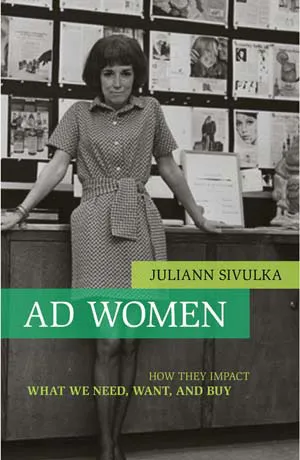
Ad Women
Juliann Sivulka Ad Women: How They Impact What We Need, Want, and Buy Prometheus Books415 pages, 6 x 9 inches ISBN 978 1591026723
Available here →February 17, 2009
20090217-sivulka-juliann-ad-women-how-they-impact-what-we-need-want-buy-3
A close-up
The rest of this thread

Juliann Sivulka
Juliann Sivulka is Professor of American Studies at Waseda University in Tokyo, Japan. She is the author of Stronger than Dirt: A Cultural History of Advertising Personal Hygiene in America (2001) and Soap, Sex, and Cigarettes: A Cultural History of American Advertising (1998). Sivulka holds a B.A. in Marketing from Michigan State University, a B.F.A. and an M.F.A in Advertising Design from the Academy of Art College in San Francisco, as well as an M.A. and a Ph.D. in American Culture Studies from Bowling Green State University. She lives in Tokyo, which gives her an international perspective on the current global advertising landscape. Before joining the Waseda faculty in 2004, Sivulka was a professor at the University of South Carolina, a Fulbright lecturer in Japan (2001-2002), and a lecturer at the Academy of Art University. A marketing communications expert, Professor Sivulka has also held corporate positions and provided consulting services in the San Francisco Bay area.
Pull this thread
Women produced the bulk of woman-centered advertising and supplied the woman's viewpoint that organized the mass-consumer industries.
Know something the rest of us don't?
Most threads on Rorotoko begin with our invitation. Any thread can begin with a proposal: you write it with the same prompts every thread answers, and we review it.
Propose a thread →