
Louis Kaplan
The Strange Case of William Mumler, Spirit Photographer
For a quick zoom, I refer the reader to Mumler’s most famous spirit photograph and to the passages where he recounts this strange visitation in his memoirs, The Personal Experiences of William Mumler in Spirit Photography (1875). This is the amazing image where the ghost of the assassinated president Abraham Lincoln comes back to give comfort to his wife, Mary Todd Lincoln, who was an ardent Spiritualist throughout her life. One notices that the ghost of Honest Abe stands behind Mary Todd and that he even has his hands around her shoulders in a show of support and in a pose typical for many of Mumler’s ghostly images. The loving gesture and its haptic quality illustrates the affective power of these images to put people in touch with the dearly departed and to help them with the mourning process. One also notices that the ghost of their son Thaddeus appears on the left hand side of the image—Mary Todd received two spirits for the price of one.
As Mumler recounts and as the image shows, the former First Lady appeared to him as a “black widow” dressed in the garb of mourning and wearing a veil which she only removed for the photograph. Mumler also tells us that Mary Todd took the assumed name of Mrs. Lindall when she visited his Boston studio in 1872. Obviously, Mumler would like his readers to believe that here was a situation of strict anonymity and that there was no way that he could have known the identity of his sitter or her beloved ghost. Interestingly enough, the New York photographer Abraham Bogardus also took a photograph of P.T. Barnum with the ghost of Lincoln hovering over him and this was presented as evidence for the prosecution at the trial in 1869 to show that such spirit photographs could be produced by mechanical means. From the perspective of the skeptic, one is struck by Mumler’s audacity in taking advantage of the poor widow with his photographic magic tricks. From the perspective of the believer, one is struck by Mary Todd’s conviction that she was in the presence of a photographic miracle.
By the way, I find it uncanny that Barack Obama made a joke in the first press conference after his election as President of the United States that bears upon this close-up. When asked whether he would be consulting with former Presidents, Obama answered that he would seek out only those who are still living. The implication being that there are not going to be any seances in his White House as was the case with the Reagans and the Clintons. However, if Obama would like to style himself as a true Lincolnian in his presidency, he ought to think again. Mary Todd was known to have Spiritualist seances in the White House and these would lead to her association with our photographic hero, William Mumler.
What is it about Mumler’s story and the conjuring of these technological ghosts in photography that still resonates with us one hundred and fifty years later at the dawn of the digital era? The Strange Case of William Mumler, Spirit Photographer reminds us of the intense intertwining of the history of communications technologies with occult or paranormal phenomena in every generation. The “ghosts in the machine” can be found in every successive technological medium from telegraphy to television to cyberspace. Jeffrey Sconce has referred to this as haunted media. If you browse around the internet, you will find a wide range of popular examples of ghostly images produced by digital means as well as the same debates between skeptics and believers with the accusations of Photoshop manipulations on the one hand and the claims of New Age revelations on the other. But whether discussing Mumler or the ghost hunters of today, I take a more deconstructive approach, recalling how each side of the debate is always already haunted by and dependent upon the other. For me, it is not a question of affirming or debunking the truth claims of spirit photography. The point is rather to acknowledge spirit photography’s affective power and its ability to construct meaning and value as well as to provoke controversy and debate then and now.
This book illuminates a curious chapter in nineteenth century American history that has largely gone unnoticed even though it has major ramifications for many fields. First and foremost, the story of William Mumler and the birth of spirit photography highlight a fascinating chapter in the history of photography, deserving of its place in the canon. The book would appeal to history buffs of the American Civil War period because of the many renowned personages (often Mumler’s clients) who walk through its pages. It has major significance for religious studies in light of the way in which it implicates the history of Spiritualism. Mumler’s famous trial also raises interesting issues about the use of photographic evidence in a court of law and this makes the book quite relevant for legal studies. Given that the book elucidates Mumler’s case history through theories derived from psychoanalysis and deconstruction, it impacts and implicates these fields of study as well. Finally, I believe that everyone enjoys a good ghost story and I want us all to remember that, whether dead or alive, photography gives up the ghost.
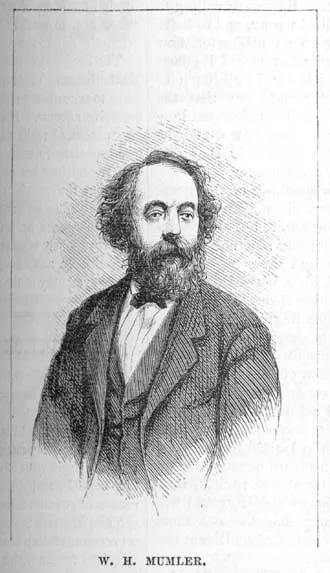
W.H. Mumler in Harpers Weekly, May 4, 1869
Editor: Erind Pajo

The Strange Case of William Mumler, Spirit Photographer
Louis Kaplan The Strange Case of William Mumler, Spirit Photographer University of Minnesota Press 288 pages, 6 1/8 x 9 1/4 inches ISBN 978 0816651573 ISBN 978 0816651566
Available here →February 27, 2009
20090227-kaplan-louis-strange-case-william-mumler-spirit-photographer-3
A close-up
The rest of this thread
Jason Walters
Louis Kaplan
Louis Kaplan is Associate Professor of History and Theory of Photography and New Media in the Graduate Department of Art at the University of Toronto and Director of the Institute of Communication and Culture at the University of Toronto Mississauga. His books include American Exposures: Photography and Community in the Twentieth Century (Minnesota, 2005), Laszlo Moholy Nagy: Biographical Writings (Duke, 1995), and The Damned Universe of Charles Fort (Autonomedia, 1993) as well as numerous essays on marginalized knowledges in modern and contemporary cultural studies. He also serves on the international advisory board of the journal Photography and Culture.
Pull this thread
Whether Mumler's spirit photographs were fraudulent is the wrong question.
Know something the rest of us don't?
Most threads on Rorotoko begin with our invitation. Any thread can begin with a proposal: you write it with the same prompts every thread answers, and we review it.
Propose a thread →