
Carole Levin
Dreaming the English Renaissance
Throughout history people have taken their dreams very seriously. Dreams themselves, and the way we interpret them, take us into the deepest part of our individual as well as cultural psyches. Dreams indicate to us the ways in which we are fundamentally the same as peoples of earlier times and also the ways in which we are deeply different. Dreams, and discussions of dreams, can give us information about the most significant issues of a historical period, especially the sites where religion and politics, as well as death and power, intersect. Popular literature and historical documents from early Renaissance England include a remarkable number of recorded dreams and a considerable discourse on their meanings. While some dreams are specific to their time period, others are timeless and universal.
Dreaming the English Renaissance looks at theories about dreams in Renaissance England, actual dreams found in letters and diaries, and dreams as they are presented in histories, drama, and political tracts. There were recipes for avoiding nightmares and for having pleasant or exciting dreams. Some argued they could learn the future from their dreams, while others insisted that one’s dominant “humour”–what we today would consider personality type–caused the dreams one had. Dreams helped discover murderers, were sent as warnings to monarchs, and were often the heartbreaking experiences of those who had lost or would lose someone they deeply loved. Examining dreams in the English Renaissance allows us to know much more about what these people believed and what they valued.
Editor: Erind Pajo
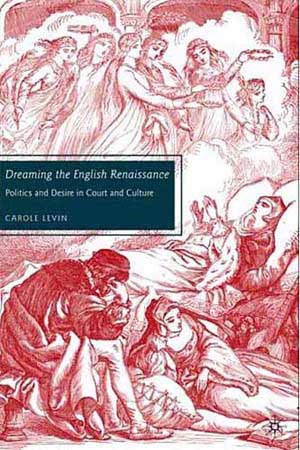
Dreaming the English Renaissance
Carole Levin Dreaming the English Renaissance: Politics and Desire in Court and Culture Palgrave Macmillan 224 pages, 6 1/8 x 9 1/4 inches ISBN 978 1403960894 ISBN 978 0230602618
Available here →March 6, 2009
20090306-levin-carole-dreaming-english-renaissance-politics-desire-court-1-1
In a nutshell
The rest of this thread

Dior Azcuy / Lincoln Journal Star
Carole Levin
Carole Levin is Willa Cather Professor of History and Director of the Medieval and Renaissance Studies Program at the University of Nebraska. She is the author of a number of books including The Heart and Stomach of a King: Elizabeth I and the Politics of Sex and Power, The Reign of Elizabeth I, and the forthcoming Shakespeare's Foreign Worlds, co-authored with John Watkins. She did some of the research and writing of Dreaming the English Renaissance while on National Endowment for the Humanities long term fellowships at the Newberry Library in Chicago and at the Folger Shakespeare Library in Washington DC. She is the co-curator of the exhibit “To Sleep Perchance to Dream” up at the Folger Shakespeare Library, February–May, 2009.
Pull this thread
Dreams are historical evidence, not psychological data.
Know something the rest of us don't?
Most threads on Rorotoko begin with our invitation. Any thread can begin with a proposal: you write it with the same prompts every thread answers, and we review it.
Propose a thread →