
Antoni Kapcia
Cuba in Revolution
Essentially this book was written in an attempt to explain to the interested lay reader why a curious phenomenon still called 'the Cuban Revolution' had managed to survive for so long, despite everything that had happened to it or been thrown against it over five decades. Whatever one feels about the Revolution, its greatest achievement may well be the simple fact of its survival against all the odds. And let us remember what the 'odds' have been: almost five decades of US economic sanctions—still in existence and now easily the longest sanctions in history, repeated crises, the collapse and disappearance of the Soviet Union and the rest of the Socialist Bloc in 1989-91, and finally the slow retirement of Fidel Castro between 2006 and 2008.
I intended the book to go beyond the usual explanations–and, I think, somewhat hackneyed or clichéd explanations–i.e. that the survival of the Cuban Revolution is due to Soviet support, fierce repression, some sort of mindless popular loyalty to the charismatic authority of a single leader, and so on.
At best, those reasons can only explain part of the longevity. But for the most part they simply succeed in distorting our understanding. Above all, those explanations miss the enormous complexity of the political system which has been built up in Cuba since 1959.
The book itself was actually based on my inaugural professorial lecture at the University of Nottingham in 2004. In that lecture, 'Reassessing the Cuban Revolution: past, present – and future', I managed to predict that Fidel Castro would stand down in 2009. I got the date wrong by one year, but, in my defence, Castro’s retirement was accelerated by a serious illness which no one foresaw. That prediction was based on my reading of the process of Revolution and the politics of Cuba—a reading which, I hope, has gone into this book.
Editor: Erind Pajo
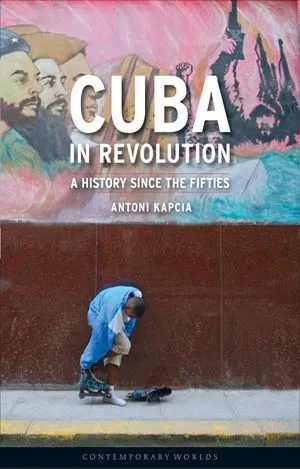
Cuba in Revolution
Antoni Kapcia Cuba in Revolution: A History Since the Fifties Reaktion Books 272 pages, 8.4 x 5.4 inches ISBN 978 1861894021
Available here →March 31, 2009
20090331-kapcia-antoni-cuba-revolution-history-since-fifties-1-1
In a nutshell
The rest of this thread

Simon Collins
Antoni Kapcia
Antoni Kapcia has been researching and writing prolifically on Cuba since 1971. His books include Cuba. Island of Dreams, about the workings of ideology and political myth, and the cultural history Havana: The Making of Cuban Culture. After studying at University College London (B.A. and Ph.D.), Kapcia lectured in Latin American studies (1974-2003) at what eventually became the University of Wolverhampton, then moved to the University of Nottingham where he become Professor of Latin American History and Director of the Centre for Research on Cuba / Cuba Research Forum. He was made Profesor Invitado at the University of Havana in 1998.
Pull this thread
pulls againstpulls alongside
The Cuban Revolution survived on loyalty generated by cubanía, the belief in an independent and socially just Cuba.
Against MB · Modern advertising differs in kind from everything before it, and for the first time it meets no legal resistance. On: Ordinary people support harmful regimes and systems from genuine conviction rather than from manipulation
Against TM · The welfare queen survives because stories demand antagonists, detail and resolution, and only better-told stories can dislodge her. On: A practice that persists over long periods does so because it works
Against FM · Most of the world now lives in one built form designed by hedge funds and algorithms that nobody will claim. On: Ordinary people support harmful regimes and systems from genuine conviction rather than from manipulation
Against RL · People diagnosed with psychopathy are not meaningfully more violent than other offenders, and the diagnosis should leave legal use. On: A practice that persists over long periods does so because it works
Alongside BM · The marriage of evangelical religion to free-market economics is a product of the service economy. On: Ordinary people support harmful regimes and systems from genuine conviction rather than from manipulation
Alongside EB · Mutual-aid structure makes radical religious groups lethal, so governments should compete with them in providing benign services. On: A practice that persists over long periods does so because it works
Alongside FD · Poor Americans' patriotism is a reasoned sense of ownership, not stupidity or false consciousness. On: Ordinary people support harmful regimes and systems from genuine conviction rather than from manipulation
Alongside CS · Companies that last a century beat the market by being intelligently conservative, not by bold bets on great ideas. On: A practice that persists over long periods does so because it works
Know something the rest of us don't?
Most threads on Rorotoko begin with our invitation. Any thread can begin with a proposal: you write it with the same prompts every thread answers, and we review it.
Propose a thread →