
E. Paul Zehr
Becoming Batman
Chapter 13 is entitled “Injury and Recovery: How Much Banging until the Batback Goes Bonk?” When thinking of Batman, people tend to often think of his gear and technology, often overlooking that Batman’s fragile human body is inside all that gear and tech.
A body is getting bashed around inside the Batsuit. So, while Batman may not have a lot of cuts, he will have loads of bruises, crush injuries, and concussions. There would be the cumulative effect of injuries and the stresses and strains of pushing his body so much and being pummeled so often. It is realistic to imagine that a person could sustain some of the beatings he takes and survives.
However, to be repeatedly subjected to such beatings, and survive, and still beat all attackers is not realistic. Neither is the lack of concussions. Batman would have a concussion from almost every encounter he is shown in. This includes falling off buildings or slamming into walls (or cars, or… whatever). Related to this idea of the body inside the suit is the need for Batman to deliberately try to get his body ready for fighting.
When Batman hits the goons of Gotham, the forces involved hit him right back! In chapter 11, “Hardening the Batbody: Can sticks and stones break his bones?” readers would find out about how important special techniques of body conditioning would be to Batman. He needs to train the bones of his arms and hands to be able to withstand these forces.
This requires hitting hard objects. The bones of his legs are pounded into the ground on a daily basis so they are well conditioned. However, since Batman doesn’t run around on his hands, his arms need special training. This is a common principle of many martial arts traditions and Batman would need to use it. The bottom line of Becoming Batman is to get across the idea that the human body has tremendous capacity for adaptation. Given the necessary combination of genetics, training, drive, skill, and lots of money it is physically possible for a very unique and special human being to become Batman.
But, due to all the stresses and injuries, it would take a really long time and it would be difficult to actually be Batman for long. The idea of becoming Batman is really a metaphor for human performance. Exploring this metaphor, the book’s most important point is that we humans have tremendous potential to tap into and use to achieve what we set out to achieve.
The key to unlocking the inner superhero in all of us is always doing the best we can at every single thing we do and never giving in or giving up. If there is one real-life lesson from Batman, that is it. We all have a bit of Batman deep inside of us. It is up us to find it and put it to use.
Editor: Erind Pajo
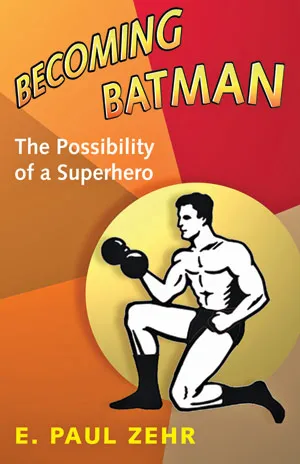
Becoming Batman
Paul Zehr Becoming Batman: The Possibility of a Superhero Johns Hopkins University Press 328 pages, 81/2 x 6 inches ISBN 978 0801890635
Available here →May 27, 2009
20090527-zehr-paul-becoming-batman-the-possibility-of-a-superhero-3
A close-up
The rest of this thread

E. Paul Zehr
E. Paul Zehr, PhD, is professor of neuroscience and kinesiology and director of the Centre for Biomedical Research at the University of Victoria. He is head of the Rehabilitation Neuroscience Laboratory with a research program focused on the neural control of movement and recovery of walking after stroke and spinal cord injury. He has a tremendous passion for the popularization of science and is involved in numerous outreach activities. His recent pop-sci books include Becoming Batman (2008) and Inventing Iron Man, both featured on Rorotoko.
Pull this thread
A human being really could become Batman, but cumulative concussions would soon end the career.
Know something the rest of us don't?
Most threads on Rorotoko begin with our invitation. Any thread can begin with a proposal: you write it with the same prompts every thread answers, and we review it.
Propose a thread →