
Shirley Anne Warshaw
The Co-Presidency of Bush and Cheney
In the past month or so, we have seen former Vice President Cheney aggressively respond to charges by President Obama that the Bush administration exacerbated America’s friends and foes with its policies of torture, prisoner abuse, and inadequate trials. In fact, Dick Cheney is the one to be blamed for these. It was not only Cheney’s policies that became the policies of the Bush administration, but they survived legal tests within the administration because of the legal team that Cheney put in place.Lawyers in the Office of Legal Counsel within the Department of Justice and in the White House Counsel’s Office provided the constitutional justification for Bush to move forward these policies. They were lawyers that Cheney and his staff placed there. Each shared Cheney’s view that the president had essentially unlimited authority under Article II of the Constitution to do what he felt was necessary to protect and defend the nation. Unlimited authority – neither prohibitions by statute nor international treaty could restrict the president’s constitutional authority to protect and defend under this interpretation. Within the administration, Secretary of State Colin Powell and his staff, including his legal counsel, William Taft IV, were among the few who objected. Their views were quickly dismissed by Cheney. It is questionable whether Bush even heard the full range of their objections.Clearly, Cheney controlled the debate over whether or not to proceed into Afghanistan and Iraq and he controlled the debate over how the wars were prosecuted. He controlled the debate by controlling the participants in the debate – nearly all of whom he had placed there. Bush, to his great fault, never reached out to a larger audience and never sought multiple voices in the policy debate. His was an administration dominated by the group think of Cheney’s allies. Had Bush spent the time to seek outside legal, constitutional, and national security voices, surely the national response to the terrorist attacks of September 11th would have been quite different.But Cheney’s voice in the administration ran far deeper than national security policy. Upon taking office in 2001, Cheney’s primary goal was to build a pro-business administration which moved toward deregulation. For Cheney, the financial costs imposed by federal regulation were an unwarranted and unnecessary constraint on business and industry.During the transition, Cheney staffed the administration with pro-business executives and lobbyists whose only goal was to dismantle the regulatory constraints, particularly environmental constraints on energy producers. Placing an oil and gas lawyer from Texas as head of the Consumer Products Safety Commission was only the tip of the iceberg of Cheney’s anti-regulatory appointees.Oil and gas companies successfully permeated the senior halls of government as Cheney appointees and focused on removing environmental regulations that prohibited drilling on federal lands, such as the Arctic National Wildlife Reserve in Alaska and the coastal shelves off of Southern California and Florida. Similarly, coal company executives appointed by Cheney dismissed environmental regulations requiring removal of waste materials in mountain coal mining, thus leading to significant pollution of the stream water surrounding the mines.Cheney shaped the Bush administration’s energy, environmental, pro-business, and national security policies. Not surprisingly, Cheney’s pick for chairman of the president’s Council of Environmental Quality, housed in the White House, was a lawyer, James Connaughton, who specialized in defending General Electric against paying for Superfund cleanup. Connaughton then chose as his deputy the chief lobbyist from the American Petroleum Institute, Philip Cooney. This was a pattern repeated across the administration. To head the Forest Service, Cheney brought in a logging executive. To head the Office of Information and Regulatory Affairs within the Office of Management and Budget, Cheney brought in a cost-benefit analysis expert who consistently argued that government had to weigh the cost to business of a public policy decision. A limited health risk did not justify the added costs to business imposed by added regulations, he argued. And then there were the pro-business efforts to outsource fifty percent of the federal government. This, of course, had the added benefit of reducing the institutional memory of career employees and of minimizing congressional oversight of administration activities – both of which Cheney championed.The co-presidency of Bush and Cheney was based on a division of labor, with Bush focused on the faith-based presidency and Cheney on most else.Bush built his presidency on creating a moral and civil society, words which he frequently used in describing the central goal of his administration. At the heart of his moral and civil society was ensuring that children had quality education – hence his promotion of the “No Child Left Behind” bill – and that the faith-based organizations, particularly churches, be central to federal delivery of social services. As an evangelical Christian, Bush was deeply engaged in using his religious tenets to serve as the tenets of public policy in building a moral and civil society. He prohibited federal funding for stem cell research, abortion and abortion counseling and ensured federal funding for abstinence education in public high schools, religious counseling for troubled teens and for prisoners, and used religious litmus tests in federal hiring.While Bush focused on his limited agenda of a faith-based government, Cheney essentially focused on everything else. Cheney’s control of the hiring process during the transition allowed him to build the government that protected an anti-regulatory business-oriented government. But Cheney’s legacy was even more substantial, for it was Cheney who crafted the imperial presidency that allowed Bush to determine the constitutionality of laws (addressed through signing statements). And it was Cheney appointees that allowed Bush to move forward a view that the president had almost unlimited constitutional power to protect and defend the nation in any way he believed was necessary – including the use of torture.I hope that The Co-Presidency of Bush and Cheney sheds new light on the limited agenda that George W. Bush had as president and the far larger agenda that Dick Cheney had as vice president – as well as the tools Cheney employed to move that agenda forward. To some extent Bush was a willing partner in the co-presidency. However, I doubt that Bush fully understood the degree to which Cheney stacked the administration with his own loyalists, particularly the positions in key legal offices. Without the legal decisions rendered by Cheney’s appointees, Bush would not have pursued the aggressive national security positions that Cheney championed.
Editor: Erind Pajo
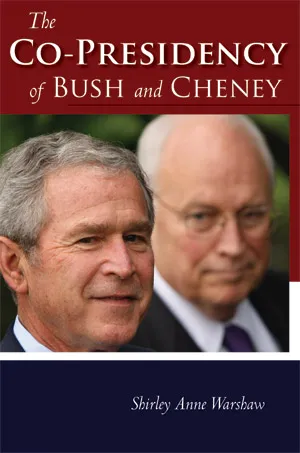
The Co-Presidency of Bush and Cheney
Shirley Anne Warshaw The Co-Presidency of Bush and Cheney Stanford University Press320 pages, 9 x 6 inches ISBN 978 0804758185
Available here →June 22, 2009
20090622-warshaw-shirley-anne-co-presidency-bush-cheney-3
A close-up
The rest of this thread

Shirley Anne Warshaw
Shirley Anne Warshaw is author of eight books on presidential power and Professor of Political Science at Gettysburg College. As an expert on presidential decision-making, White House organization, and White House-Cabinet relations, Warshaw is quoted in newspapers, seen on television across the country, and contributes regularly to National Public Radio. Married with three children, she holds a Ph.D. from Johns Hopkins University, a Master’s degree from the Wharton School of Finance and Commerce, and a B.A. from the University of Pennsylvania.
Pull this thread
Cheney was a co-president, and the mechanism was staffing, loyalists placed across the administration so every memo reached him.
Know something the rest of us don't?
Most threads on Rorotoko begin with our invitation. Any thread can begin with a proposal: you write it with the same prompts every thread answers, and we review it.
Propose a thread →