
A close-up
July 20, 2009
The Once and Future New York
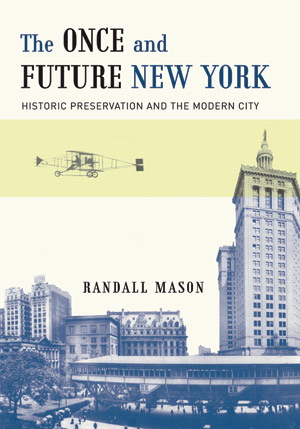
These two “close-ups” might compel readers:The first is the book’s collection of images. The portfolio, chapter images and the book’s cover capture the extraordinary moment in New York’s history in which the book is set. In the 1900s and 1910s, New York was perched on the brink of becoming “the capital of capitalism,” the epitome of modern metropolises. Yet at the same time some of its leading citizens were thoroughly devoted to preserving material aspects of the city’s past as part of its public space.
This cultural foment—searching for usable pasts in all forms of culture—enabled images mixing past and future in delicious ways: the airplanes hovering above old City Hall (spliced in by the photographer), streetcars rushing past vernacular buildings as the photographer tried to capture a portrait, an architect (Hugh Ferris, known as champion of the New York skyscrapers) lovingly sketching an historic church about to be lost, Bronx River Parkway images of “before” and “after” proudly documenting slum clearance and landscape design.
The second “close up” is the revelation that preservation depends so much on destruction, that old buildings (those associated with the “wrong” memories) are not infrequently destroyed at the insistence of preservationists.
That preservationists rely on destroying buildings as much as saving them is one of those great ironies that reveal so much about the discourses and images preservationists project. There are many examples of selective destruction in the service of historic preservation. Williamsburg, the famous historic site in Virginia, was “restored” as an 18th town in the 20th century by destroying a lot of buildings created in the 19th century. Independence Hall in Philadelphia (where I teach) has a vast lawn in front where whole city blocks were cleared in the 1950s to create a proper “jewel box” setting for the main attraction—Independence Hall itself.
The built environments imagined and designed by preservationists are often highly selective—some memories are in, other are out. In preservation parlance, this is the “scrape” approach used by restorers (such as Viollet, or Scott), as opposed to the “anti-scrape” attitude of Ruskin and Morris. The 19th-century debate between these approaches continues to animate historic preservation in the 21th century.
Why do preservationists use destruction as one of their tools? Preservation is about shaping and sustaining memory—particular, collective, historical memories—and fundamentally not just about saving old buildings and objects. Saving old stuff—in preservationist parlance, “historic fabric”—is a means to the end of shaping collective memory. Forgetting this context of their work, preservationists too often fetishize a few old buildings, and sound like self-righteous, narrow-minded, arrogant connoisseurs.
One of the main lessons we can take away from the preservationists I write about is the deep meaning and abiding value of dealing with the built environment holistically. Preservationists understood buildings, parks, monuments, museums, and natural places as sources of meaning for citizens. Providing access to such places as public resources—beyond the ability of markets to provide them—was a brave and revolutionary gesture of reform and an enlightened way to recognize how people experience places.
This holistic perspective has mostly been lost, especially among professional designers, planners, and preservationists. But as a community we are desperately trying to regain it—witness all our strenuous talk of sustainability.
We have learned all too well to separate natural and cultural aspects, historic and not historic aspects, beautiful and ugly aspects, profitable and not profitable aspects of built environments, instead of connecting them. We divide up the world according to the disciplines we represent—history, economics, architecture, etc. The world of design, planning and preservation has a great deal to contribute to making our lives richer, more meaningful, healthier, more aligned with the holism of “environment.” We can enable people to see their own environments with new eyes. But we won’t realize this potential to make the world better unless we transcend disciplinary strictures and biases.
Once and Future New York reminds us of this by putting on display the very holistic, publicly minded work of preservation advocates of a century ago. By combining their deep feeling for the past with the present needs of their city they demonstrated holistic thinking we would do well to emulate.
Editor: Erind Pajo
The Once and Future New York
Randall Mason The Once and Future New York: Historic Preservation and the Modern City University of Minnesota Press 344 pages, 10 x 7 inches ISBN 978 0816656042
Get the book →July 20, 2009
20090720-mason-randall-once-future-new-york-historic-preservation-city-mode-3
The rest of this thread

Charles Lawrence
Randall Mason
Randall Mason is trained in geography, history, and planning, and earned a doctorate from Columbia University. As an Associate Professor at the University of Pennsylvania’s School of Design, Mason teaches historic preservation and city planning. He worked previously at the Getty Conservation Institute, University of Maryland, and Rhode Island School of Design. Besides The Once and Future New York, he has also authored, with Max Page, Giving Preservation a History (Routledge, 2004). Mason’s recent research and professional projects include work in Philadelphia, New York, Nassau, and New Mexico.
Feature your book
Publishing with a small press, or on your own?
A Sponsored Thread runs like every other thread on Rorotoko: three parts on three dates, the same editorial review, your own pages in the archive. Marked Sponsored. $199, paid only once accepted.
Feature your book →