
Lewis H. Siegelbaum
Cars for Comrades
The spatial requirements and landscape consequences of the automobile age – the roads, oil and gas refineries and stations, garages, tire and parts stores and junk yards, billboards and flashing neon signs, suburban tracts and shopping malls – hardly made their presence felt in the USSR. “Consequently,” wrote a Dutch-born writer in the late 1960s “the Westerner in his own car …moves in an odd way back through time” to “how [our world] once looked, how it was supposed to look.”
Still, already in 1960, Krokodil, the Soviet humor magazine, could print a cartoon of makeshift sheds disfiguring the courtyard of a new apartment bloc, and residents in Leningrad soon were lodging complaints about garages getting “in the way of people’s everyday lives.”
The proliferation of private automobiles also had temporal consequences as car owners required considerable amounts of time to maintain and repair their vehicles.Hence, car owners and car parts suppliers both of whom were overwhelmingly male appropriated courtyards, alleys, roadsides and fields for the predominantly masculine activities of car work and car talk. Garages, furnished with old chairs and perhaps a heater and a cot became sites of celebration – places to drink vodka and consume sausage and pickles. They and the interiors of the cars themselves served as alternative living rooms for men seeking privacy and male companionship.
The essentially private activities in which they engaged thanks to the car and the infrastructural inadequacies of the centrally planned economy were beyond the surveillance not only of their wives but of the state that inadvertently had fostered them.All of this was a long way from the vision of Valerian Osinskii, a prominent Bolshevik who did more to give life to the Soviet automobile than anyone else. In a series of articles that Pravda published in 1927, Osinskii called upon his comrades to adopt the “American automobile” instead of the “Russian cart” and thereby put “every worker and peasant in a car within not more than ten to fifteen years.” Osinskii also dreamed of a future in which a car trip from Moscow to the provincial town of Voronezh would mean traveling on an asphalt highway so smooth that the only sound heard would be the swish of tires.
Only since the collapse of the USSR have such journeys become possible, but at the same time, the post-Soviet landscape is now littered with the detritus of the automobile age.In the late 1950s, Nikita Khrushchev, who never had been a fan of the private car, proposed a rental system as an alternative route to automotive modernity. “We will use cars more rationally than the Americans,” he assured an audience in Vladivostok. But even before his ouster in 1964, the system that had lacked funding and provoked innumerable complaints was phased out. With it went the chance for the USSR to take advantage of its relatively late entry into the automobile age and improve on the record of its predecessors.
Cars for Comrades is about more than cars. It is about the chimera of overcoming the gap in technology between the capitalist (First) and socialist (Second) world. Even as Soviet and American engineers were installing an assembly line to turn out Model A trucks and cars in the late 1920s, Soviet journalists were conjuring up visions of a technological utopia, not just a factory out of which would rumble identical machines one after the other, but an entire city, the “City of Socialism” lit by electricity, heated by steam, and with rectangles everywhere. But the capitalist world’s technology was a moving target. By the time the techno-utopian “Soviet Detroit” of the future was actually built – in the early 1970s in Togliatti to complement the AvtoVAZ factory – the real Detroit was definitely showing signs of stress and decay from which it would not recover.
The book’s larger significance is about the intersection of technology, ideology, and material culture. I argue that Soviet socialism exchanged the possibility of an alternative modernity for one much more entangled with the material culture of the western world.
This process was difficult to predict. For much of its existence, the Soviet Union was defined by its leaders as a more rationally organized and socially just polity than any in the capitalist world. The preponderance of trucks – those workhorses among motor vehicles – and the rare privately owned car was consistent with such difference. But eventually the comrades and other middle-echelon personnel wanted to enhance their personal mobility, flexibility, and status. They wanted the wealth within what had become a vast empire to be shared with them not only in the form of access to first-rate educational institutions, vacations abroad, family apartments, and domestic appliances but that most representative of twentieth-century material objects – the car.In the end, they got their way, sort of.
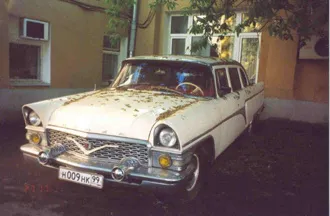
A Chaika in the courtyard of a Moscow apartment building, May 2006. Photo Lewis Siegelbaum.
Editor: Erind Pajo
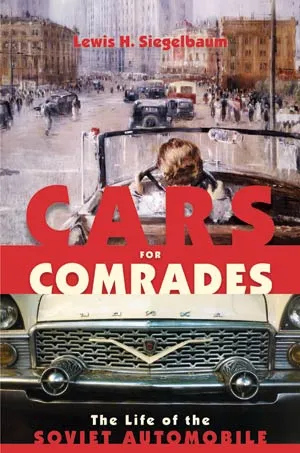
Cars for Comrades
Lewis H. Siegelbaum Cars for Comrades: The Life of the Soviet Automobile Cornell University Press309 pages, 9 x 6 inches ISBN 978 0801446382
Available here →August 3, 2009
20090803-siegelbaum-lewis-on-cars-for-comrades-life-soviet-automobile-3
A close-up
The rest of this thread
.webp)
Doug Elbinger
Lewis H. Siegelbaum
Lewis H. Siegelbaum is professor of Russian history at Michigan State University. He received his D.Phil. from Oxford University in 1976 and taught at La Trobe University in Melbourne, Australia until 1983. He is the author of Stakhanovism and the Politics of Productivity in the USSR, 1935-1941 (1988), Soviet State and Society between Revolutions, 1918-1929 (1994), and Stalinism as a Way of Life (2000, co-authored with A. Sokolov). In 2007-08 he was a Fellow at the Netherlands Institute for Advanced Study in the Humanities and Social Sciences (NIAS). His work in Soviet history has been animated by an interest in technology, ideology, and material culture.
Pull this thread
Soviet middle echelons finally demanded the car as their share of the empire's wealth, and they got it.
Know something the rest of us don't?
Most threads on Rorotoko begin with our invitation. Any thread can begin with a proposal: you write it with the same prompts every thread answers, and we review it.
Propose a thread →