
Chad Heap
Slumming
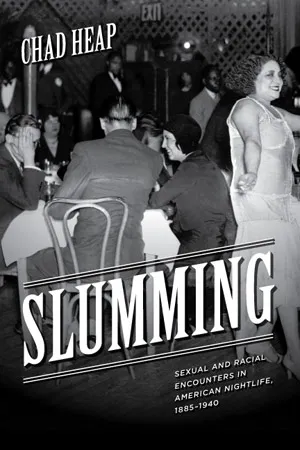
Although I hesitated to put a Harlem image on the cover of Slumming, precisely because I wanted to challenge the almost exclusive association of that neighborhood with my book’s topic, I eventually resolved that no other illustration so accurately captured the complex racial and sexual dynamics of the phenomenon.
A rare image of slummers apparently caught in the act, this 1929 Bettmann/Corbis photograph (which also appears in its original, uncropped form on page 202 of the book) depicts a full-bodied female entertainer “shaking her shimmy” among several tables of white and black patrons at the popular nightspot known as Small’s Paradise. In the background, a black jazz band accompanies the sassy dancer and several likely members of the cabaret’s black waitstaff stand ready to deliver bootleg liquor to the tables. But it is the foreground of the image that is most remarkable.
The picture ostensibly centers on the female entertainer, but in effect the photographer has framed his subject along much the same lines that I followed when writing my book. That is, he has inverted the conventional focus of slumming, shifting the viewer’s gaze from the black nightlife the slummers have come to see onto the white pleasure seekers themselves. The result is an astonishing depiction of the patrons’ wide-ranging responses to the camera’s presence—responses that raise nearly as many questions as they answer about the slummers’ activities.
Why, for instance, do none of the white patrons sitting closest to the entertainer actually watch her perform? And why, as Lori Brooks asked in a recent Times Higher Education review, have the men at that table covered their faces or turned their backs to the camera, while the woman seated with them seems to chuckle with amusement? What is one to make of the pair of women sitting to the right of the shimmying dancer (visible in the uncropped version of the photograph) who seem enraptured with her performance? Or of the black man and the white man at one of the back tables (also visible in the original image) who sit quite close to one another and seem to stare down the camera?
Like the photographer, I seek to capture the full range of slummers’ reactions, exploring whether pleasure seekers were motivated by some momentary thrill of crossing racial and sexual boundaries or by a deeper sense of cross-racial or sexual alliance or attraction. But unlike the photographer, I also document the full range of responses that slummers generated from the residents of the communities they visited—from complicity and profiteering to a sense of unbridled rage that affluent whites dared to treat their neighborhoods as an erotic playground.
One could easily argue that all historical research, writing, and even reading constitute a form of slumming. Each invites the historically curious individual to venture into unknown territory or to encounter new groups of people in an effort to better understand both the unfamiliar and oneself.
But Slumming is less a meditation on the way that history is written or consumed than an exploration of the pervasive but changing power of race and sexuality in American culture, the inextricability of these two concepts in the popular imagination, and the ability of urban amusements to make such abstract notions seem more stable and “real” by grounding them in particular urban spaces.
Yet even as Slumming endeavors to unravel the cultural dynamics of this voyeuristic, oft-demeaning but always revealing practice, it clearly runs the risk of promoting some version of “armchair slumming” among readers. No doubt some will find parts of the book titillating and sensationalistic. But in critically analyzing and historically contextualizing even the most salacious accounts of past social and sexual interactions, I seek to make productive use of the voyeuristic aspects of such research in order to reveal the complex, sometimes exploitative and often erotic processes through which racial and sexual ideologies were constructed more than a century ago and through which they continue to find their power today. If the result of my endeavors proves as pleasurable and stimulating as it is informative, so much the better.
Editor: Erind Pajo
Slumming
Chad Heap Slumming: Sexual and Racial Encounters in American Nightlife, 1885-1940 University of Chicago Press 432 pages, 9 x 6 inches ISBN 978 0226322438
Available here →August 7, 2009
20090805-heap-chad-slumming-sexual-racial-encounters-american-nightlife-3
A close-up
The rest of this thread

Jérôme Bernard
Chad Heap
Chad Heap is Associate Professor of American Studies at George Washington University, where he teaches courses on gender and sexuality in American culture. He has held fellowships from the Social Science Research Council’s Sexuality Research Fellowship Program and from the Newberry Library in Chicago. In addition to Slumming, he is the author of Homosexuality in the City: A Century of Research at the University of Chicago, the catalogue for an exhibition of the same name that he curated for the Special Collections Research Center at the University of Chicago Library. Currently he is working on a reconstructed ethnography of Chicago’s Depression-era gay community, based on roughly forty life histories and other unpublished field notes gathered by a University of Chicago sociology graduate student during the latter half of the 1930s.
Pull this thread
Fifty years of slumming produced the white/black racial axis and the hetero/homo binary in reciprocal relation to each other.
Know something the rest of us don't?
Most threads on Rorotoko begin with our invitation. Any thread can begin with a proposal: you write it with the same prompts every thread answers, and we review it.
Propose a thread →