
Karen Newman
Essaying Shakespeare
I guess I’d direct a browsing reader to my last essay: any writer is always most interested in his or her current work.A colleague, Margaret Ferguson, observed over twenty years ago that “the historical fate of the British Empire challenges the idea that explaining oneself to literal and figurative foreigners is an unnecessary activity.” I’m interested in how Shakespeare has become both “foreign” (students occasionally ask me for “translations” of his plays and some high schools actually use “No Fear” or “modern” translations) and yet so completely familiar that we quote his plays without even knowing it. How to explain plays written over 400 years ago to “literal and figurative foreigners”? We have all become “foreigners” to Shakespeare.
Cultural translation is an activity to which I am keenly committed, both by training and temperament, as a scholar working in comparative literature, interested in languages, and as a world citizen of culture. Yet I am also a Shakespearean, which seemingly poses a paradox, for Shakespeare is the quintessential national poet.
Shakespeare’s plays are said to articulate Englishness. They have been quoted by generations of British monarchs and statesmen, and by generals in times of war. “Bardolatry” as one scholar has put it, is “a national religion.”
The plays are produced regularly throughout both the UK and the US, and over 400 years after Shakespeare’s birth, they remain a staple of the Anglo-American school and university systems. The recent “discovery” of a supposed new portrait of Shakespeare made the front page of the New York Times and caused great excitement because in the new portrait Shakespeare is handsome and well-off rather than the balding, middle-aged man he was until recently. Shakespeare’s First Folio, a large commemorative folio volume of his plays published a few years after his death—is perhaps the most famous book in English—and certainly today one of the most expensive.
But the earliest advertisement for Shakespeare’s first collected works appeared in 1622, in an appendix of English works at the end of a book catalogue in Latin. The catalogue listed the books for sale at the important book fair held every spring and autumn at Frankfort-on-the-Main in what is now Germany, and which is still held today. It contains the entry “Playes, written by M. William Shakespeare, all in one volume, printed by Isaack Iaggard, in. fol. (from the Latin word for leaf: the book was in the form of a full-sized sheet of paper folded only once).
It is astonishing that Shakespeare’s First Folio was first offered for sale not in England, but at a European market, in a supplemental listing of English books to a Latin catalogue for a German book fair. What interests me is that the ad insists that even before there were modern nation states, Shakespeare was always already multilingual and international, an incipient global cultural commodity.
The globalization of culture is often assumed to be a late twentieth-century phenomenon, the result of an expansion and acceleration in the movement and exchange of ideas, commodities and capital over vast distances and porous boundaries. Narratives of cultural imperialism abound about “Americanization” or western cultural hegemony. Yet long before Shakespeare became the British “national poet” famously celebrated “as the patron spirit of world empire on which the sun will never set,” even before, in fact, the famous First Folio saw print in 1623, booksellers were peddling their intellectual property in Shakespeare internationally. Translation, both literal and cultural, allows for the afterlife of Shakespeare by allowing the plays to continue to live in different cultural moments and far flung cultural geographies.
At the end of the introduction to Essaying Shakespeare I write that my ambition for the book is that it will be of interest not only to scholars—Shakespeareans—but also to graduate and undergraduate students, and, perhaps most importantly, to the general reader. But that, dear reader, is for you to decide.
Editor: Erind Pajo
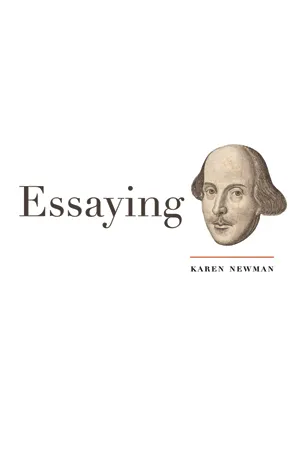
Essaying Shakespeare
Karen Newman Essaying Shakespeare University of Minnesota Press232 pages, 9 x 6 inches ISBN 978 0816655892ISBN 978 0816655908
Available here →August 24, 2009
20090824-karen-newman-on-essaying-shakespeare-3
A close-up
The rest of this thread

Karen Newman
Karen Newman is Professor of English at New York University. She has written widely on Shakespeare and Renaissance letters and culture and is the author of several books including Shakespeare’s Rhetoric of Comic Character (Methuen, 1985), Fashioning Femininity and English Renaissance Drama (Chicago, 1991), Fetal Positions, Individualism, Science, Visuality (Stanford, 1996), Cultural Capitals: Early Modern London and Paris (Princeton, 2007) and Essaying Shakespeare (University of Minnesota Press, 2009). Before coming to NYU, she was University Professor and Professor of Comparative Literature and English at Brown University. She has also taught at Williams College, The Johns Hopkins University and Harvard University. Her current research on cultural translation aims to historicize contemporary claims about the globalization of culture.
Pull this thread
Shakespeare was an international commodity before he was a national poet, advertised at the Frankfurt book fair in 1622.
Know something the rest of us don't?
Most threads on Rorotoko begin with our invitation. Any thread can begin with a proposal: you write it with the same prompts every thread answers, and we review it.
Propose a thread →