
Cliff Edwards
Mystery of the Night Café
Page one of the book invites the reader into the actual “Night Café” on Tuesday evening, September 4,1888, when Vincent Van Gogh set up his easel to spend three nights painting the café on the ground floor of his rooming-house in the City of Arles, in southern France. Each chapter then examines the café as Van Gogh saw it, the letters in which he discusses it, and the books he had been reading that influenced his literary imagination which interpreted that café.I believe those early chapters will carry the reader along with a string of clues that are both convincing and revealing of the artist’s intent. For example, I ask the reader to consider both what is present in the Night Café and what was present but is now absent. Is it significant that after midnight only the lowest of the low, those without a home to which they can return, remain? Does Van Gogh, a homeless foreigner in Arles, identify with those few remaining “night prowlers?”
Further into the book, I suggest clues that carry me more deeply into the painting’s meaning. But I present them as speculative possibilities that the intelligent and focused reader may decide to accept or may decide to reject.
Those speculative directions have to do with favorite art works and biblical texts that Van Gogh himself claims had special meanings for him. For example, Van Gogh describes Jesus as “the greatest of all artists,” and focuses on the parables as among the greatest of all works of art. Further, he notes that Saint Luke is the “patron saint of artists,” and favors Luke’s Gospel. This will finally lead me to suggest that Van Gogh does have a parable from Luke in mind as one aspect of his view of the Night Café.If I were to give away the specifics of the string of clues and supportive texts here, it would spoil one dimension of the interested reader’s experience of the book.
The overall significance of the book raises the question of the power of art itself in human life, and the manner in which a single work of art might unlock an artist’s deepest beliefs regarding the meaning of our existence. By focusing on a single work defined by an exceptional artist as having “deep meaning,” we put to the test the view of Paul Tillich that works of art open dimensions of reality that are otherwise closed to us, and similarly, open otherwise closed dimensions of the soul.
Editor: Erind Pajo
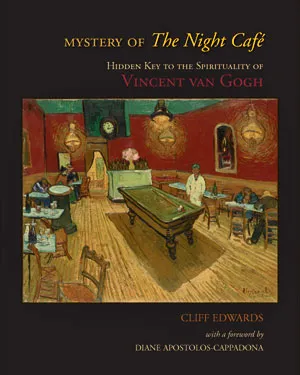
Mystery of the Night Café
Cliff Edwards Mystery of the Night Café: Hidden Key to the Spirituality of Vincent Van Gogh SUNY Press 116 pages, 9 x 7 inches ISBN 978 1438426112 ISBN 978 1438426129
Available here →August 26, 2009
20090826-edwards-cliff-mystery-night-cafe-spirituality-vincent-van-gogh-3
A close-up
The rest of this thread
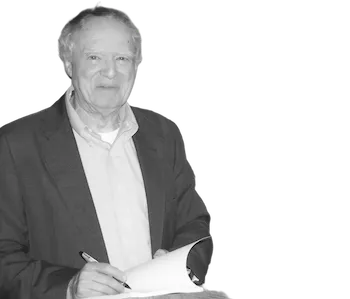
Cliff Edwards
Dr. Edwards’ education has spanned East and West, studies in spirituality, world religions, literature, and the arts. His Ph.D. in the history and literature of religions was earned at Northwestern University. He studied at the University of Strasbourg in France, the University of Neuchatel in Switzerland, and the Daitokuji Zen monastery in Kyoto Japan. He has been a Visiting Fellow of Oxford University, and has lectured at museums and centers of the arts in the United States and abroad. He is currently professor of religion and the arts at Virginia Commonwealth University in Richmond, Virginia.
Pull this thread
The Night Café encodes Van Gogh's sense of life's meaning, clue by clue, resting on a parable from Luke.
Know something the rest of us don't?
Most threads on Rorotoko begin with our invitation. Any thread can begin with a proposal: you write it with the same prompts every thread answers, and we review it.
Propose a thread →