
David S. Powers
Muhammad is Not the Father of any of Your Men
The non-specialist who is browsing through the book should turn to chapter one, where I discuss the foundation narratives of Judaism, Christianity, and Islam. It is interesting that all three narratives are formulated in the idiom of family relationships. In all three cases, it is the same family that is the subject of the respective narratives, albeit at a different stage in history.
Genealogical connections are critical. Just as Jesus is said to have been a lineal descendant of Abraham through David, Muhammad is said to have been a lineal descendent of Abraham through Ishmael.Narratives about domestic relations within the household of the founder are the stage upon which key theological doctrines are performed.
The biblical doctrine of divine election emerges from the story of Abraham’s relationship with his wife Sarah, his concubine Hagar, and his sons Ishmael and Isaac. Similarly, the Christian doctrine of divine sonship emerges from the details of domestic relations within the household of Joseph, Mary, and Jesus. In both cases, the father-son motif is linked to the theme of sacrifice: God tested Abraham by ordering him to sacrifice his beloved son Isaac; and God the Father did sacrifice His beloved son Jesus. The parallel is no coincidence.
The Christian claim to supersede Judaism is closely related to the narrative dynamics of the Israelite family saga.The revelations received by Muhammad were intended to restore the religion of Abraham, which had been only imperfectly preserved by Jews and Christians. At the same time that the Qur’an confirms the general contents of the Hebrew Bible and New Testament, it also corrects errors that are said to have crept into the earlier sacred scriptures.
It is important to note that in the Qur’an, prophecy is portrayed as the exclusive possession of a single family that includes Adam, Noah, Abraham, Isaac, Ishmael, Jacob, Moses, David, Solomon, and Jesus. In other words, the office is hereditary.In light of the importance of Abraham and Jesus in the Qur’an, one might expect to find a variant of the father-son cum sacrifice motif in the Islamic foundation narrative. If so, this expectation is disappointed. Muhammad is said to have had thirteen wives and concubines, with whom he produced four daughters and four sons. All four of his sons, however, are said to have died before reaching the age of maturity.
Thus, God apparently could not test the Prophet by instructing him to sacrifice any of his sons.In Muhammad Is Not the Father of any of Your Men, I argue that Muhammad’s sonlessness was a theological imperative and that, initially, the father-son motif did play a key role in the formation of the Islamic foundation narrative. Whereas the sons of the Jewish foundation narrative (Ishmael and Isaac) are the natural born offspring of their father, and the son of the Christian narrative is the supernaturally born Son of his Father, the son of the Islamic narrative—a man named Zayd—is the adopted son of his father.
The existence of Zayd is known to most Muslims, although no theological significance is attached to the father-son relationship. Similarly, students of Islamic history are familiar with Zayd, although no scholar has attempted to explain Muhammad’s relationship with his adopted son in the context of the father-son motif that plays such an important role in Judaism and Christianity.
It is this adopted son of Muhammad’s who stands at the center of my book. Although Zayd may have been an historical figure, the narratives about him are best seen, in my view, as artful literary compositions. In these narratives, Zayd’s primary function—indeed, one might say, his sole function—is to make it possible for Muhammad to become the Last Prophet. He was a resounding success.
The first Muslims constructed their foundation narrative in such a manner as to insure the integrity of the bold new claim that the office of Prophecy closed with the death of Muhammad. To this end, they revised the text of the Qur’an, abolished the institution of adoption and reformed the rules of inheritance.
One element of this strategy involved the creation of a narrative in which Muhammad takes his daughter-in-law and makes her his wife. Recall my argument that the original reading of Q. 4:12 refers to a man who designates his daughter-in-law or wife as heir. Muslims who were familiar with both the narrative and the verse had to ask themselves: Did Muhammad designate Zaynab as his heir? It was, in part, in order to make sure that no one would ever ask this question that the text of Q. 4:12 was revised by changing kalla (“daughter-in-law”) to kalala.
The word kalala was an artificial creation that did not exist during Muhammad’s lifetime and it only entered the Arabic language in the years following his death. Because there is no equivalent of kalala in any other Semitic language, its meaning could only be derived from context. The first exegetes advanced several different definitions of the word. In the end, the Islamic understanding of the word (“collaterals”) was grounded in the authority of the first caliph Abu Bakr, who is reported to have said, “I have expressed my own personal opinion on kalala. If it is correct, it is from God; if it is mistaken, then it is from me and from Satan.” The sentiment expressed in this statement merits further investigation.
Editor: Erind Pajo
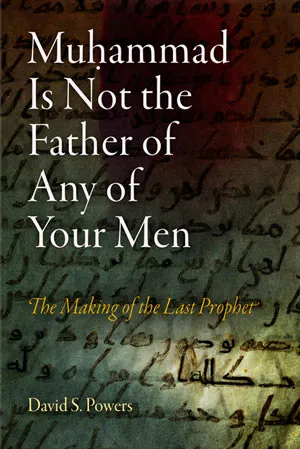
Muhammad is Not the Father of any of Your Men
David S. Powers Muhammad is Not the Father of any of Your Men: The Making of the Last Prophet University of Pennsylvania Press376 pages, 6 x 9 inches ISBN 978 0812241785
Available here →September 4, 2009
20090904-powers-david-muhammad-not-father-any-your-men-making-last-prophet-3
A close-up
The rest of this thread

David S. Powers
David S. Powers is Professor of Near Eastern Studies at Cornell University. Besides the books mentioned in the Rorotoko interview, he has also authored Law, Society and Culture in the Maghrib, 1300-1500. He is founding editor of the journal Islamic Law and Society and Sectional Editor (Law) of the third edition of the Encyclopaedia of Islam.
Pull this thread
The early Muslim community added one letter to the Qur'an to protect the doctrine that prophecy ends with Muhammad.
Know something the rest of us don't?
Most threads on Rorotoko begin with our invitation. Any thread can begin with a proposal: you write it with the same prompts every thread answers, and we review it.
Propose a thread →