
Mark McGurl
The Program Era
A reader riffling through the pages of my book might be struck to see that a work of literary history has so many diagrams. What’s up with that? Don’t we go to literature to avoid things like diagrams? I would hope that the reader would find the diagrams intriguing, and see how they correspond to the more finely grained descriptions of writers and their works that make up the bulk of the book.
I have lots of favorite parts of the book, of course, but many readers have seemed particularly interested in my account of Ken Kesey. Who would have thought that one of the ultimate 1960s counterculture figures was also a creative writing program graduate? And who knew that his teacher was another important American writer, Wallace Stegner?
That these two men basically hated each other is fascinating, considering how productive and revealing their relationship turned out to be. And that they were, in turn, part of a much broader cultural context—not only Stanford University but the whole Bay Area just as it was beginning to convulse into “the sixties”—gives this part of the book a lot of energy.
It’s so easy to hate institutions. The very word has come to stand for something depressing and bad.
But institutions are the medium of collective human endeavor, and need to be protected from the corrosive myths of radical individualism that would tear them down.
I confess that I love the kind of institutions called schools, and want them to thrive. And it bothers me when they are understood merely as tools of oppression and standardization. Schools can certainly be that, but shuttering or defunding them is no solution to the problems they try to solve.
Better is to ask ourselves how schools can be made more responsive to our needs, including our need for creativity.
If my book can help us reach a more complex and sympathetic understanding of how schools have tried to enlist themselves in support of that ultimate form of individualism—creative writing—it will have done something worthwhile.
Editor: Erind Pajo
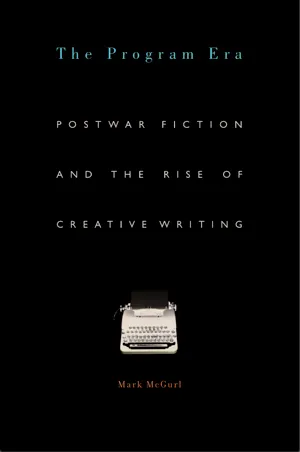
The Program Era
Mark McGurl The Program Era: Postwar Fiction and the Rise of Creative Writing Harvard University Press 480 pages, 9 x 6 inches ISBN 978 0674033191
Available here →September 7, 2009
20090907-mcgurl-mark-on-program-era-postwar-fiction-creative-writing-3
A close-up
The rest of this thread

Mark McGurl
Mark McGurl was born in Salem, Massachusetts and educated at Harvard University. Since earning his Ph.D. from Johns Hopkins he has been a professor of American literature at UCLA, where he has been the recipient of numerous awards and fellowships.
Pull this thread
pulls againstpulls alongside
Postwar American fiction is the product of the creative writing program, which is creativity's medium rather than its antagonist.
Against AG · In research universities the best scholars make the best leaders, and a hospital should be led by a doctor. On: Exceptional achievement is explained by individual endowment rather than by circumstance and training
Against PB · Corporate support for Black culture is diversity capital, an asset the firm accumulates for itself. On: Being absorbed into an institution or a market degrades an art form or a movement
Against HS · Inge Lehmann discovered the Earth's solid inner core in 1936, and her achievement is larger for what it cost her. On: Exceptional achievement is explained by individual endowment rather than by circumstance and training
Against LM · UNESCO's heritage work was forged by the colonizing powers as the last gasp of the civilizing mission. On: Being absorbed into an institution or a market degrades an art form or a movement
Alongside SB · What school produces is largely non-learning, and that is a property of the structure, not of the students. On: Exceptional achievement is explained by individual endowment rather than by circumstance and training
Alongside SB · Late-GDR experimental artists worked through state art schools and official venues, and the Stasi's outsized presence was ineffective. On: Being absorbed into an institution or a market degrades an art form or a movement
Alongside JB · Jeanneret borrowed and plagiarized Freemasonry's symbols to win commissions from a ruling class that sat in the lodges. On: Exceptional achievement is explained by individual endowment rather than by circumstance and training
Alongside TB · Mann's American celebrity was manufactured, and it worked because he was sold as representing a German tradition Nazism had perverted. On: Being absorbed into an institution or a market degrades an art form or a movement
Know something the rest of us don't?
Most threads on Rorotoko begin with our invitation. Any thread can begin with a proposal: you write it with the same prompts every thread answers, and we read it.
Propose a thread →