
Ramón E. Soto-Crespo
Mainland Passage
In the book’s introduction I explain Puerto Rico’s state in relation to other commonwealth states.Chapter One, “State and Artifice,” examines the eighteenth-century paintings of José Campeche and the nineteenth-century painting of Francisco Oller to show the importance of the political state in Puerto Rican culture. In this context, painting provides a visual account of the discursive limits of the Puerto Rican state. More importantly, painting captures the idea of a passage in the Puerto Rican imagination where stasis and mourning are left behind in favor of an unconventional future.Chapters Two and Four, “The Mainland Passage” and “Out of the Mainland,” examine closely the prose and poetry, of the Latina and Nuyorican writers in the U.S. mainland. Nuyorican poetry tells us the unknown history of the mainland passage from the perspective of those communities that were formed in the urban areas of metropolitan New York City. Boricua politics, their invention, provides us with an account of the development and perseverance of a Puerto Rican identity in the diaspora. For this purpose, I examine previously overlooked publications by urban political writers that provide us with detailed accounts of those political changes in the Nuyorican enclaves of New York.Chapter Three, “Escaping Colonialism,” scrutinizes Puerto Rico’s Commonwealth Constitution and elucidates the political strategies behind its institutionalization in 1951.Mainland Passage challenges readers to understand non-normative forms, of governance and of belonging, in their own context. This implies not only diversity on different modalities within the nation-state form, but also diversity in the shape of those forms themselves.In the Puerto Rican context it means that a non-normative state was institutionalized in 1951. It means that this borderland state introduces an affirmative perspective in the Puerto Rican context. In the Latin American context the borderland state challenges the idea of nation-state or political nationalism as the only possible venue for the creation of a collective entity.To embrace this institutionalized political form means to affirm cultural difference. To negate it, to claim that it is colonial, would only lead to a rejection of one of the most insightful contributions to contemporary global diversity.In other words, to fail to understand the Puerto Rican borderland in its own right would lead us to a world ruled by more of the same.
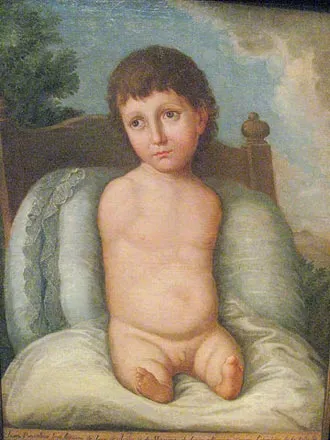
José Campeche, El Niño Juan Pantaleón Avilés de Luna Alvarado, c. 1808. Oil on canvas. 271/4 x 19 inches. Collection of Instituto de Cultura Puertorriqueña.
Editor: Erind Pajo

Mainland Passage
Ramón E. Soto-Crespo Mainland Passage: The Cultural Anomaly of Puerto Rico University of Minnesota Press200 pages, 9 x 6 inches ISBN 978 0816655885
Available here →September 14, 2009
20090914-soto-crespo-ramon-on-mainland-passage-cultural-anomaly-puerto-rico-3
A close-up
The rest of this thread

Ramón E. Soto-Crespo
Ramón E. Soto-Crespo is Associate Professor of American Studies and Director of the Latina/o Studies Program at the State University of New York at Buffalo. His essays have appeared in ALH, MLN, MFS, Contemporary Literature, Textual Practice, and in publications by the University of Chicago Press.
Pull this thread
The Puerto Rican commonwealth is a borderland state, a distinct political form, so statehood and independence are false alternatives.
Know something the rest of us don't?
Most threads on Rorotoko begin with our invitation. Any thread can begin with a proposal: you write it with the same prompts every thread answers, and we review it.
Propose a thread →