
Barry Seldes
Leonard Bernstein
I wrote the Introduction as a mise en scène that would set the stage for what comes next—a tale of presidential betrayal of an American artist (by Truman and Eisenhower). In a larger sense, my work indicates how the arts are not separated from the domestic and international political milieus, from political and social forces. In other words, the aesthetic terrain is not in some pristine place but is instead linked to structures of power.I think that my book makes much of this clear by focusing not on abstract theory but on the concrete, human case.
Leonard Bernstein was, of course, a composer and conductor living in Cold War America. As composer of Broadway musical theater, he was subject to the demands of the Cold War culture industry for creative expression. Dissident and daring, Bernstein tested the limits imposed by orthodoxy—e.g., by naming and opposing the military-industrial complex and its adventures and expeditions around the globe.
But Bernstein did not broach those limits. In the sixties and later on, Bernstein did attack that complex, its promotion of an expansionist foreign policy and its most visible manifestation, the war in Vietnam. And Bernstein did not stop there: he also attacked racism and homophobia, in the 1977 Songfest and in public address.
The reader will learn from the section on Gustav Mahler how Bernstein’s championing of that composer fits into the socio-political analyses of Bernstein’s life-long projects.I want to see this book as making a contribution not only to our understanding of Leonard Bernstein, but to see in him a case in the larger study of the confluences and transactions between the arts and the forces that govern the social order.
There are a number of such studies, e.g., on Dimitri Shostakovich, on Aaron Copland, and another, forthcoming, on Bernstein’s theatrical works by a politically-informed musicologist.I’d like to see other such studies that will indicate the relative porosity or supposed impregnability of the boundaries that nominally separate the aesthetic from the socio-political realms. Such understanding will illuminate the ways in which social forces condition individual thinking and acting, and thereby constitute our very beings.
Editor: Erind Pajo
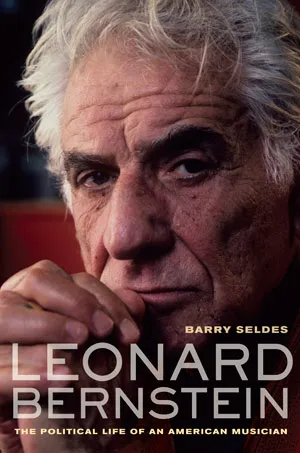
Leonard Bernstein
Seldes, Barry Leonard Bernstein: The Political Life of an American Musician University of California Press296 pages, 9 x 6 inches ISBN 978 0520257641
Available here →October 7, 2009
20091007-seldes-barry-leonard-bernstein-political-life-american-musician-3
A close-up
The rest of this thread

Barry Seldes
Barry Seldes is professor of political science and American Studies at Rider University, where he has taught for four decades. He has published and lectured widely on topics of politics and culture, with foci on music and cinema. He is currently writing a book on the late critic Susan Sontag.
Pull this thread
Bernstein's politics and his music were a single life.
Know something the rest of us don't?
Most threads on Rorotoko begin with our invitation. Any thread can begin with a proposal: you write it with the same prompts every thread answers, and we review it.
Propose a thread →