
Philip Goodchild
Theology of Money
Capital growth begins with borrowing for investment. For all economic activity is limited by the supply of money: there is always so much more that could be done, if only more money were available. As Samuel Butler put it, “It has been said that the love of money is the root of all evil. The want of money is so quite as truly.”
If money can be created in the form of loans for the purpose of profitable activity, then effective limits to economic growth are removed. There is no shortage of money when it can be replaced by credit, and repaid at a profit. The consequence was nothing less than Karl Polanyi’s “great transformation”: production for the sake of profit rather than use became the dominant motivation for social activity and interaction.
Capitalism, its growth and its globalization, is explained by banking. Economic activity, formerly a limited segment of social life, came to predominate over all other aspects of social life, including religion. The preachers’ declamations against the evils of usury and the love of money were unheeded by those who saw the evidence of prosperity brought about through profit.
Prior to the modern world, the economic sphere was bounded by the finitude of the production of value through human labour, on the one hand, and the finitude of money in circulation, on the other. In the modern world, however, the finitude of production has been partially overcome by harnessing energy stored in fossil fuels and the elements. At the same time, the finitude of currency has been overcome by treating signs of monetary value as themselves valuable, ensuring the value of newly created money by issuing it in the form of loans, attached to debts. Rates of production and rates of interest escape finitude by compound growth. Production for the sake of profit replaces production for the sake of use. It is easy to observe how such an activity naturally leads to secularization and a direct opposition between God and money. Where God promises eternity, money promises the world. Where God offers a delayed reward, money offers a reward in advance. Where God offers himself as grace, money offers itself as a loan. Where God offers spiritual benefits, money offers tangible benefits. Where God accepts all repentant sinners who truly believe, money may be accepted by all who are willing to trust in its value. Where God requires conversion of the soul, money empowers the existing desires and plans of the soul. Money has the advantages of immediacy, universality, tangibility, and utility. Money promises freedom, and gives a downpayment on such a promise of prosperity.
This is a prophetic and apocalyptic book, not only in its dire predictions about the immediate future and its pessimism about the demonic hold that debt has over our lives, but also in its attempt to explain and judge the entirety of modern life.
No one can remain neutral in regard to the book’s central thesis. So I expect it to be deeply divisive at best, or else regarded with such scandal and outrage that it must be denounced, marginalised or ignored.
The book calls into question an entire modern worldview shared by religious and non-religious alike. It does, however, give an explanation for the perverted balance of priorities in our society that many ordinary people feel deeply uneasy about.
My hope is that it will be a provocation for thinking, and that it may set up the terms of the problem so that new institutions can be devised that liberate human evaluation and cooperation from the constraints of debt money in a future era of our civilisation.
Editor: Erind Pajo
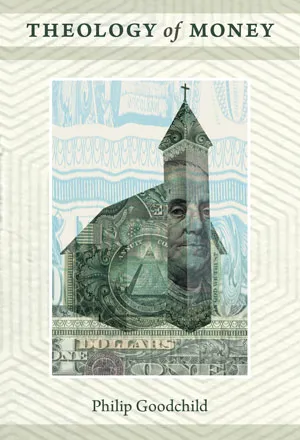
Theology of Money
Philip Goodchild Theology of Money Duke University Press 304 pages, 9 x 6 inches ISBN 978 0822344506 ISBN 978 0822344384
Available here →November 30, 2009
20091130-goodchiled-philip-on-theology-of-money-3
A close-up
The rest of this thread
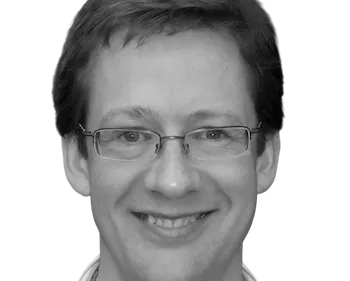
Philip Goodchild
Philip Goodchild is Professor of Religion and Philosophy at the University of Nottingham in the UK. He is the author of Gilles Deleuze and the Question of Philosophy (1996), Deleuze and Guattari: An Introduction to the Politics of Desire (1996), and Capitalism and Religion: The Price of Piety (2002), as well as editor of Rethinking Philosophy of Religion (2002) and Difference in Philosophy of Religion (2003).
Pull this thread
Modern money is bank credit, therefore debt, and debt has replaced God as the guarantee of human cooperation.
Know something the rest of us don't?
Most threads on Rorotoko begin with our invitation. Any thread can begin with a proposal: you write it with the same prompts every thread answers, and we review it.
Propose a thread →