
Jennifer M. Barker
The Tactile Eye
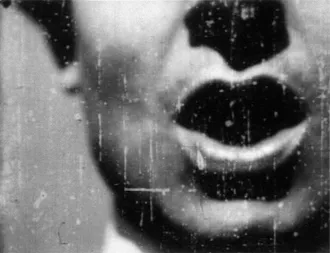
The full-bodied, mutual suffusion of film and viewer is illustrated graphically and literally by The Big Swallow (James Williamson, 1901). The film begins with a medium-long shot of a gentleman gesturing angrily and shouting (silently, of course) at the camera, presumably because he does not want to be photographed. He moves aggressively closer and closer to the camera until his wide-open mouth blocks the view entirely, seeming to swallow up the camera. An invisible cut to a black background creates a void, into which the flailing cinematographer and his old-fashioned camera pitch forward and disappear. Another invisible cut brings us back to the gentleman’s open mouth, and he retreats from the camera, chewing and laughing at his clever triumph over the cinematographer and the apparatus.
The film’s provocative premise suggests that while cinema has an astonishing ability to “draw us in” to its spectacle, the positions of film subject, viewer, and filmmaker are tenuous at best in this exchange. The film appears to engulf not only the cinematographer and the apparatus but also, by extension, the viewer. The cinematographer is at first unseen, as the man being photographed walks toward the camera, but as the gentleman opens his mouth, the cameraman tumbles with his equipment into the gaping mouth of what had been, just a moment before, the filmed image of the gentleman.
Because of the cinematographer’s absence from the first image, we the viewers share his position; we initially view the filmed man from the same position that the cinematographer does. Thus, when the cinematographer is swallowed up, so must we be. But we are left alive to see the swallowing up, now outside the relationship we’d been part of a moment before, and in the final shot the gentleman grins smugly at the camera despite the fact that he has just been seen to devour said camera in a single bite. The film turns inside and outside itself and back again, swallowing itself up and spiting itself back out, in the space of a few seconds. The Big Swallow forces the question, where are we in this picture? The ambiguity of Williamson’s film suggests the tactile, corporeal, reversible contact between film and spectator, who embrace or even ingest one other—in both directions—and yet do not disappear into one another entirely. The Big Swallow depicts quite literally and imaginatively the intimate and tactile crossover of the inside and the outside, of the subject and the object of this tactile vision. The film’s final return to the smiling man at the end of the film places the emphasis squarely on the film experience taken as a whole, rather than on subject or object, viewer or viewed. That ambivalent but sensuous tactile contact between film and viewer moves all the way through the skin, musculature, and viscera, so that we are inside the film and outside it at the same time. Film theory and criticism have often described the meeting place of film and viewer as a mirror, a screen, a window, or a door. No one metaphor sticks, perhaps for two reasons. First, the “stuff” of the contact between film and viewer is too permeable and flexible to be described in quite these rigid terms. Second, what keeps us separate from the film isn’t a “thing” at all, but our bodies’ own surfaces and contours.
Philosopher Maurice Merleau-Ponty’s notion of “flesh” (which differs dramatically from literal skin) may be a better metaphor. The material contact between viewer and viewed is less a hard edge or a solid barrier placed between us—a mirror, a door—than a liminal space in which film and viewer can emerge as co-constituted, individualized, but related, embodied entities.
The notion of “flesh” encourages us to see the connection between film and viewer not only as a tactile “interface,” but perhaps even further as a mutual immersion. More than that, it may encourage us toward a new style of historiography, theory, and criticism. Indeed, I am convinced that the (re)invention of moving image studies and the mutual absorption of film and viewer are closely related.
Insightful critical writing about cinema requires a passionate, sensuous approach that respects the passionate, sensuous, and specifically tactile engagement between viewers and films. It’s my hope that The Tactile Eye helps to encourage this embrace of sensual experience not only for the purposes of description, but also as an integral tool for film history and theory.
Editor: Erind Pajo

The Tactile Eye
Jennifer Barker The Tactile Eye: Touch and the Cinematic Experience University of California Press 208 pages, 9 x 6 inches ISBN 978 0520258426
Available here →December 11, 2009
20091211-barker-jennifer-on-tactile-eye-touch-cinematic-experience-3
A close-up
The rest of this thread

Naomi Shersty
Jennifer M. Barker
Jennifer M. Barker teaches in the Moving Image Studies program in the Department of Communication at Georgia State University. She received her Ph.D. in Critical Studies from UCLA. Her research interests include synaesthesia and the senses; theories of spectatorship, affect, and embodiment; and intersections between film and the other arts. Her published essays have dealt with cinematic spectacle, ethnographic documentary, and feminist experimental film.
Pull this thread
Film viewing is tactile contact between two bodies, the viewer's and the film's own.
Know something the rest of us don't?
Most threads on Rorotoko begin with our invitation. Any thread can begin with a proposal: you write it with the same prompts every thread answers, and we review it.
Propose a thread →