
Monika Zagar
Knut Hamsun
Hamsun’s actions in the few short summer months of 1943 define him, clarifying his unreserved support of the Nazi program. He writes an admiring letter to Joseph Goebbels and sends him his Nobel Prize medal as a gift; he delivers a speech at the Press Internationale in Vienna in June of 1943 in which he expresses a worldview consistent with the Nazi politics of the day, his racist rhetoric identical to that of the congress organizers, and his personal voice intertwined with the prevailing propaganda; and he has a personal meeting with Hitler at the Fuhrer’s Eagle’s Nest sanctuary, arranged by high party functionaries after Hamsun’s supportive speech in Vienna. The above facts, for all the mitigating circumstances one would wish to consider, confirm that Hamsun indeed believed in the project of the Third Reich.
Two years later, on the occasion of Hitler’s death, Hamsun wrote a glowing obituary. By extension, it is also interesting how the official 1946 psychiatric report on Hamsun avoided dealing with these facts; for instance, in reference to giving away his medal, the name Goebbels was replaced with “a German.” The question of post-war reinterpretation of Hamsun’s actions and writing thus becomes a relevant one. Hamsun’s last novel, On Overgrown Paths, uses his literary skills to skew the view of his actions and alter the reader’s judgment of him.
Apart from hard political facts, what I want a reader to discover is the more insidious side of Hamsun’s worldview, which is often congruent with the propaganda and reality of the Third Reich. If my book inspires a reader to revisit Growth of the Soil, I hope they approach it with some wonder at how hard it is on women not to be able to control their fertility and the burden they bear from repeated pregnancies. Hamsun’s praise of fertile erotic women as mothers and, in contrast, his demonizing or derogatory portrayal of women who would aspire beyond motherhood are fully fleshed out in his novel. Hamsun aspires to a utopian world where everyone is part of an organic life cycle; women and their fertility are central to this cycle. This organic life cycle should be embraced intuitively, and not be questioned.
At the end of the novel, achievements of modern progress—education, industrialization, mobility, women’s rights, modern medicine—are subsumed into this eternal life cycle. Although the novel is to a certain degree atypical for Hamsun, it expresses the author’s basic values: anti-intellectualism, anti-state and anti-parliamentary democracy, anti-progress, and anti-women’s rights. Hamsun was also against Christian morality and he endorsed natural fertility. However, he tamed women’s sexuality within patriarchal constraints, and warned against miscegenation in his other works. All of these moral values are embedded in a text that is a pleasure to read, not only because of a story well told, but also because of Hamsun’s great skill with language. It easily escapes one that all of these views, especially his view on sexuality, agree so fully with the Nazi ideology.
I would like my book to contribute to our understanding of the lives and texts of supporters of dictatorial regimes who unsettle our ethical, moral, and aesthetic judgments. The ensuing unease often results in a convenient division between dirty politics and beautiful art.
The Dark Side of Literary Brilliance is a reminder of the simple fact that so-called great men and artists are not exempt from lending support to repressive ideologies; besides Hamsun, Ezra Pound, Louis-Ferdinand Celine, and Martin Heidegger leap to mind. We, the readers, should not fall under their seductive spell, but rather should read them critically. Even masterpieces need to be read in context with other texts, and canons revisited. One can read Hamsun’s great literary works without realizing his agenda, his desire to reverse modernity and for society to reject liberal attitudes towards women and Others. Yet to read Growth of the Soil or On Overgrown Paths knowing how Hamsun felt about these issues will yield a different assessment of those works than if one reads them uninformed.
I’d also like to encourage the readers to reflect on the fact that Nazism, even if it obviously operated on intimidation and fear, was supported by small daily decisions of ordinary citizens. It was rooted in deep-seated convictions and traditions that the ideologues deftly exploited. These traditions include the power of the blood and nation, and the sanctity of motherhood and family. Hamsun did not march dressed in a Nazi uniform or display anti-Semitic signs. Yet he was in agreement with many broader premises of the National Socialist party. Other ideologies function in a similar way, and our resistance is crucial in defense of basic democratic rights.
Editor: Erind Pajo
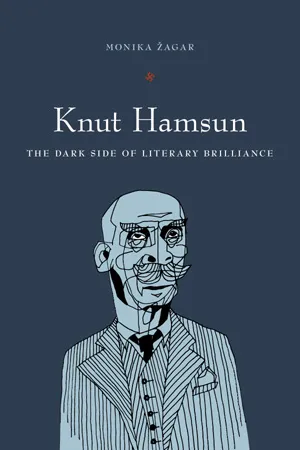
Knut Hamsun
Monika Zagar Knut Hamsun: The Dark Side of Literary Brilliance University of Washington Press 352 pages, 9 x 6 inches ISBN 978 0295989457 ISBN 978 0295989464
Available here →December 23, 2009
20091223-zagar-monika-on-knut-hamsun-dark-side-literary-brilliance-3
A close-up
The rest of this thread

Monika Zagar
Born and raised in Ljubljana, Yugoslavia, Monika Zagar studied in Sweden, Norway, and Denmark, received her Ph.D. from the University of California at Berkeley, and is now Associate Professor of Scandinavian Studies at the University of Minnesota, Twin Cities. In addition to Knut Hamsun featured in this Rorotoko book interview, she is the author of Ideological Clowns: Dag Solstad - Between Modernism and Politics (Edition Praesens, 2002), which addresses the curious phenomenon of some Norwegian writers converting to Maoism. Zagar is also co-editor, with Patrizia C. McBride and Richard W. McCormick, of Legacies of Modernism: Art and Politics in Northern Europe, 1890-1950 (Palgrave Macmillan, 2007); author of numerous articles on Scandinavian writers, gender, ethnicity, and discrimination; and co-organizer of the conference “Norway, World War II and the Holocaust” (University of Minnesota, 2007).
Pull this thread
Hamsun's collaboration was continuous with his fiction, and Growth of the Soil reads differently once that is known.
Know something the rest of us don't?
Most threads on Rorotoko begin with our invitation. Any thread can begin with a proposal: you write it with the same prompts every thread answers, and we review it.
Propose a thread →