
Henry A. Giroux
Youth in a Suspect Society
I have always been concerned about the role that theory might play as a resource in providing both a language and a context for understanding and addressing important social issues. Many narratives in this book are designed to connect peoples’ everyday lives with larger social issues. By entering the book through these narratives, the reader may connect private considerations to larger public problems, and vice versa.
The transformation of the school from an invaluable public good and laboratory for critical learning and engaged citizenship to a containment site modeled after prisons is made clear in a number of narratives concerning the abuse perpetuated in the name of zero tolerance policies. For instance, in Miami a first grader took a table knife to school, using it to rob a classmate of $1 in lunch money. School officials claimed he was facing “possible expulsion and charges of armed robbery.”
In another instance that took place in December 2004, a fourth-grade student at a Philadelphia elementary school was yanked out of class, handcuffed, taken to the police station, and held for eight hours for bringing a pair of 8-inch scissors to school. She had been using the scissors to work on a school project at home. School district officials acknowledged that the young girl was not using the scissors as a weapon or threatening anyone with them, but scissors qualified as a potential weapon under Pennsylvania state law.
Youth in a Suspect Society attempts to provide readers with a language of critique with respect to the crisis facing young people. But it does more. It also offers readers a language of possibility, one that encourages them to analyze critically the role that education, power, and politics might play in providing an alternative and better future for both young people and an aspiring democracy. It is difficult to imagine what it means to fight for the rights of children if we cannot at the same time imagine a different conception of the future, one vastly at odds with a present that can only portend the future as a repeat of itself. Within this current moment of economic uncertainty and political possibility it is necessary for educators, artists, intellectuals, and others to raise questions and develop rigorous modes of analyses in order to explain how a culture of domestic militarization and economic Darwinism—with its policies of commodification, containment, cruelty, and brutalization—has been able to develop and gain consent from so many people in the United States during the last three decades. And, most importantly, such a challenge suggests developing a new mode of politics and empowering forms of education in which a future of hope and imagination is inextricably connected to the fate of all young people, if not democracy itself.
Under the current insufferable climate of repression and unabated exploitation, young people and communities of color have become the new casualties in an ongoing war against justice, freedom, social citizenship, and democracy. I hope that Youth in a Suspect Society will provide a critical vocabulary by which to understand the current crisis of youth. I also hope that the book convince readers to reject and collectively struggle against a form of biopolitics in which life is considered cheap, markets drive politics, and those who lack resources and opportunities can be considered redundant and ultimately disposable.
At stake here is a set of larger issues: How much longer can a nation ignore those youth who lack the resources and opportunities that were available, although perhaps in a partial and incomplete way, to previous generations? What does it mean when a nation becomes frozen ethically and imaginatively so that it no longer provides its youth with a future of hope and opportunity? And what might it mean for intellectuals who inhabit a wider variety of public spheres to take a stand and to remind themselves that collective problems deserve collective solutions?
What is at risk is not only a generation of young people and adults now considered to be a generation of suspects, but also the very possibility of deepening and expanding democracy.
Editor: Erind Pajo
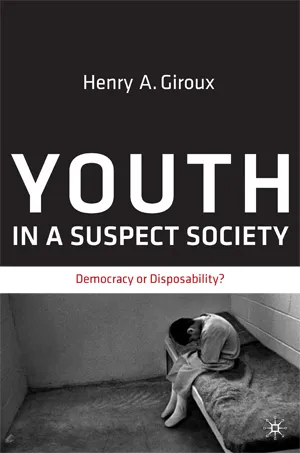
Youth in a Suspect Society
Henry A. Giroux Youth in a Suspect Society: Democracy or Disposability? Palgrave Macmillan 256 pages, 8 1/2 x 6 inches ISBN 978 0230613294
Available here →January 8, 2010
20100108-giroux-henry-on-youth-suspect-society-democracy-disposability-3
A close-up
The rest of this thread

Henry A. Giroux
Henry A. Giroux currently holds the Global TV Network Chair Professorship at McMaster University in the English and Cultural Studies Department. He has taught at Boston University, Miami University of Ohio, and Penn State University. In 2002, he was named as one of the top fifty educational thinkers of the modern period in Fifty Modern Thinkers on Education: From Piaget to the Present as part of Routledge’s Key Guides Publication Series. Giroux is on the editorial and advisory boards of numerous national and international scholarly journals, and he serves as the editor or co-editor of four scholarly book series. His most recent books include: Take Back Higher Education (Palgrave, 2004), co-authored with Susan Searls Giroux; The University in Chains: Confronting the Military-Industrial-Academic Complex (Paradigm, 2007); and Against the Terror of Neoliberalism (Paradigm, 2008).
Pull this thread
Since the late 1970s young people have gone from embodying the nation's future to being a generation of suspects.
Know something the rest of us don't?
Most threads on Rorotoko begin with our invitation. Any thread can begin with a proposal: you write it with the same prompts every thread answers, and we review it.
Propose a thread →