
Roger Ekirch
Birthright
The prologue of Birthright is the portion to which I devoted the most energy. If it does not capture the reader’s imagination, chances are that the rest of the book will not either. Commencing with the sudden death of Annesley’s father, Baron Altham, the prologue recounts James’s life as a street waif, climaxing with his abduction and being placed aboard a ship in Dublin Bay bound for America. Legal records, maps, city records, even a diary of Dublin’s weather allowed me to reconstruct this remarkable sequence of events, which is cast, unlike the remainder of the book, in the present tense.
Still and all, readers, I like to think, will profit from reading the book’s final chapter, entitled “A Note on Legal Sources.” The prose is more analytical, but I use this opportunity to sort out the conflicting legal testimony surrounding Annesley’s efforts to reclaim his birthright—to explain, in short, why I found the arguments in his favor very difficult to refute.
From the outset, I resolved to cast the tale as a narrative, an easy decision given its compelling nature. That said, a secondary goal has been to illuminate the contours of Irish society. The sheer density of the legal depositions, many containing richly detailed recollections of both rural and urban settings, is stunning. Though of varying quality and length, they speak not only of the minutiae of everyday existence—the clothing, furnishings, and customs of lords and peasants—but also of the cadences of Irish life. Ultimately, however, this remains a family drama full of unexpected twists and turns—a story about betrayal and loss, but also endurance, survival, and redemption.
Editor: Erind Pajo
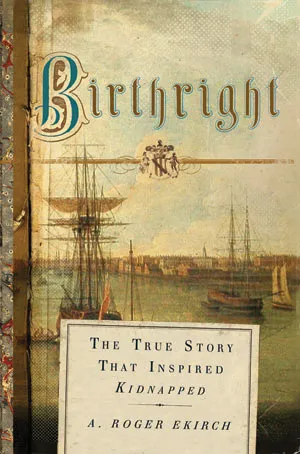
Birthright
Roger Ekirch Birthright: The True Story that Inspired Kidnapped W. W. Norton 258 pages, 8 1/2 x 6 inches ISBN 978 0393066159
Available here →January 25, 2010
20100125-roger-ekirch-birthright-true-story-inspired-kidnapped-3
A close-up
The rest of this thread

Roger Ekirch
Roger Ekirch is an award-winning historian, whose writings have been translated into eight languages. A graduate of Dartmouth College, he obtained his doctorate from Johns Hopkins University. Since 1977, he has taught at Virginia Tech. Along with three other books and sundry scholarly articles, he has written columns for the New York Times, the International Herald Tribune, and the Richmond Times-Dispatch. His path-breaking research on the history of sleep has been profiled in publications ranging from the Smithsonian Magazine and the Financial Times to Applied Neurology and Scientific American Mind. Professor Ekirch has received three fellowships from the National Endowment for the Humanities and in 1981-1982 became the first Paul Mellon Fellow at Cambridge University. In 1998, he received a coveted Guggenheim Foundation fellowship. His last book, At Day’s Close: Night in Times Past (2005), won four awards, including a prize given by the history honor society Phi Alpha Theta for the “best subsequent book” in all fields of history.
Pull this thread
The 1743 Memoirs of an Unfortunate Young Nobleman, reprinted as a novel, is substantially true.
Know something the rest of us don't?
Most threads on Rorotoko begin with our invitation. Any thread can begin with a proposal: you write it with the same prompts every thread answers, and we review it.
Propose a thread →