
Gary L. Francione
Animals as Persons
If a “just browsing” reader were to pick up Animals as Persons in a bookstore, I would hope that s/he would first encounter pages 26-28, where I first describe the phenomenon I call our “moral schizophrenia” with respect to nonhuman animals.
Our moral thinking about animals is confused to the point of being delusional. We say that we regard as morally wrong the imposition of “unnecessary” suffering and death on animals. Whatever the finer points about the meaning of necessity, if it means anything at all in this context, it must mean that we cannot justify imposing suffering and death on animals for reasons of mere pleasure, amusement, or convenience. We excoriated Michael Vick for participating in dog fighting because the dogs suffered and died only because Vick and his friends derived pleasure from this activity. But how is Vick any different from those of us who eat meat and animal products?
We kill and eat approximately 56 billion animals annually, not including fish. There is no doubt that the overwhelming majority—almost all—of these animals have absolutely horrible lives and deaths and are treated in ways that clearly and undisputedly constitute torture. The animal you ate for dinner last night—even if raised in the most “humane” or in “free-range” circumstances—was treated as badly if not worse than Michael Vick’s dogs.
And there is no distinction between meat and other animal products. Animals used for dairy are kept alive longer, treated at least as badly as animals used for meat, and end up in the same slaughterhouse. There is probably more suffering in a glass of milk than in a pound of steak.
No one maintains that it is necessary to eat animals to lead an optimally healthy lifestyle and an increasing number of mainstream health care professionals tell us that animal foods are detrimental to human health. Animal agriculture is a disaster for the environment because it involves a very inefficient use of natural resources and creates water pollution, soil erosion, and greenhouse gases. The only justifications we have for the pain, suffering, and death that we impose on billions of animals are that we enjoy eating animal foods, or that it is convenient to do so, or that it is just plain habit. We treat some nonhumans as members of our family; we stick forks into others.
In addition to demonstrating that the animal welfare approach to animal ethics is unsatisfactory both as a moral and practical matter, another significant aspect of Animals as Persons is to make the case for veganism. We should not eat, wear, or consume any animal products.
Most of the current literature on animal ethics—academic as well as commercial—defends the “conscientious omnivore” who is careful to eat only animal products that are produced in a supposedly “humane” way, or, at most, defends vegetarianism, a vague term used to describe a diet that does not include meat, poultry, and, perhaps aquatic animals. But if we take animal interests seriously and regard animals as members of the moral community, we really have no choice other than eliminating the consumption and use of all animal products. What we consume is not a simple matter of choice; there are moral issues involved.
It is my hope that the book makes clear to readers that to talk about animal rights at all when animals are chattel property is similar to talking about the rights of slaves. To be property is the opposite of being a person. A person is an entity with inherent or intrinsic value; property has only external or conditional value. At the present time, we regard only humans as eligible to be natural persons. But we should remember that, at various times, we have excluded from the class of persons certain humans based on irrelevant characteristics, such as race and sex.
Animals as Persons is a call to include all sentient beings in the class of persons and to recognize that the interest of animals in not being used as resources should, like the similar human interest in not being a chattel slave, be protected with a right.
The abolitionist position presented in Animals as Persons does not mean that we release domesticated animals to run wild in the street. If we took animals seriously and recognized our obligation not to treat them as things, we would stop producing and facilitating the production of domestic animals altogether. We would care for the ones whom we have here now, but we would stop breeding more for human consumption.
With respect to non-domesticated nonhumans, we would simply leave them alone.
Editor: Erind Pajo
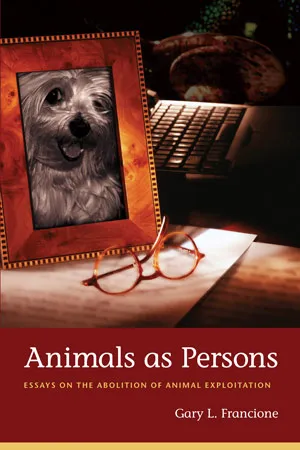
Animals as Persons
Gary L. Francione Animals as Persons: Essays on the Abolition of Animal Exploitation Columbia University Press 256 pages, 9 x 6 inches ISBN 978 0231139519 ISBN 978 0231139502
Available here →February 1, 2010
20100201-gary-francione-on-animals-as-persons-abolition-animal-exploitation-3
A close-up
The rest of this thread

N. Romanenko
Gary L. Francione
Gary L. Francione is Distinguished Professor of Law and Nicholas deB. Katzenbach Scholar of Law and Philosophy at Rutgers University School of Law. In addition to Animals as Persons, he is the author of Animals, Property, and the Law (1995); Rain Without Thunder: The Ideology of the Animal Rights Movement (1996); and Introduction to Animal Rights: Your Child or the Dog? (2000). His forthcoming book, The Animal Rights Debate: Abolition or Regulation?, will be published in March 2010 by Columbia University Press. Francione is also co-editor, with Gary Steiner, of Columbia University Press’s new series, Critical Perspectives on Animals: Philosophy, Politics, Law, and Culture.
Pull this thread
No amount of humane handling justifies using animals at all, and veganism is the floor.
Know something the rest of us don't?
Most threads on Rorotoko begin with our invitation. Any thread can begin with a proposal: you write it with the same prompts every thread answers, and we review it.
Propose a thread →