
Kevin Mattson
What the Heck Are You Up To, Mr. President?
On page 149 I start to describe the Disco Demolition rally in Chicago that occurred just a few days before Jimmy Carter gave his speech. The rally is a wonderful portrait of a chaotic America—youth streaming onto a baseball field after thousands of disco records have just been blown up amidst orgiastic chants of “DISCO SUCKS!” The chaos—stoned teenagers setting a baseball field on fire—gives the reader a sense of where America was at the time, chaotic, conflicted, and unruly. But it’s also important because disco was so central to defining 1970s American culture.
Disco had started early in the decade in a marginalized, predominantly African-American and gay urban music scene. By 1979, disco was mainstream and literally everywhere. But there was something about disco, especially in its later and more commercial renditions, that seemed fake and superficial. The kids who chanted “Disco Sucks” weren’t necessarily even aware of what they were doing. But they were showing how fed-up Americans had become with the state of their culture, among other things.
The Disco Demolition Rally gives a nice sense of just how wild things were in America at the time, with murders and riots occurring on the gas lines that were getting longer and longer. 1979 makes you realize that the chaos of the 1960s never really ended; it just turned uglier.
I hope the book helps us re-explore what were the 1970s.
The Carter presidency should not be dismissed as a blip in time before Ronald Reagan assumed power in the 1980s.
Carter had a unique vision for America’s role at home and abroad, one worth remembering as our country comes out of a very conservative period in our more recent past. Jimmy Carter’s sense that America must have a sense of humility, a realization that its power is real but also evanescent, is crucial to rethinking what we should be today. So a speech from 1979 becomes, in a way, a chance to reassess a path that we didn’t take but that we can take today.
Clearly the language that Carter used in the speech and the themes that resonated throughout it are still important today. In fact, President Obama’s inaugural address had many similar lines. Obama spoke of a “crisis of confidence” existing in America. He talked about the need to learn some hard truths about the state of our democracy. Like Carter, Obama has a deep interest in the theological teachings of Reinhold Niebuhr—who emphasized that humans are sinful and naturally self-interested. Niebuhr believed that only humility and self-inquisition could potentially prevent us from doing bad things in the world—and even still we’d likely do bad things.
Whereas Ronald Reagan used the language of America as the chosen land—something he shared with the Christian right of Jerry Falwell, and that today Sarah Palin consistently references—Carter projected a vision of America that was humble.
Carter thought that America should never think of itself in terms of “chosen” or “blessed” (the oil crisis itself showed that we weren’t). So too does Obama. And I think that a vision of America as humbled by the complexities of the world is a vision that we’re rediscovering today. As a historian, I have tried to write a book that recollects how we once had a leader with that language and how he came to decide to use that language.
Editor: Erind Pajo
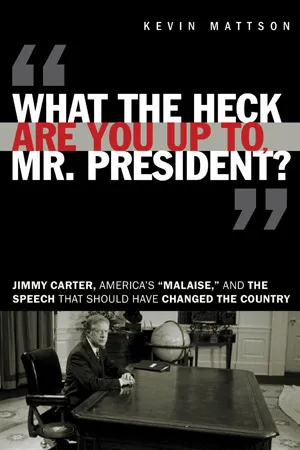
What the Heck Are You Up To, Mr. President?
Kevin Mattson “What the Heck Are You Up To, Mr. President?”: Jimmy Carter, America’s “Malaise,” and the Speech that Should Have Changed the Country Bloomsbury, 272 pages, 8½ x 6 inches ISBN 978 1596915213
Available here →February 8, 2010
20100208-kevin-mattson-on-jimmy-carter-malaise-speech-change-america-3
A close-up
The rest of this thread

Jacob Silberberg
Kevin Mattson
Kevin Mattson is Connor Study Professor of Contemporary History at Ohio University. He is author of numerous books that examine the intersection between ideas and politics. He has written for a variety of magazines, including The Nation, American Prospect, and Commonweal. He is a member of the editorial board of Dissent and serves on the National Council of the American Association of University Professors (AAUP).
Pull this thread
Carter's 1979 answer of humility and limits was the right one, and the conservative revolution was built during his presidency.
Know something the rest of us don't?
Most threads on Rorotoko begin with our invitation. Any thread can begin with a proposal: you write it with the same prompts every thread answers, and we review it.
Propose a thread →