
Joshua Clover
1989
I think in some sense any portion of the book will give a sense of it at the level of the writing, the way it wants to talk about its subjects. And it’s composed in relatively small sections, a few pages each. But I’m not sure any single passage would get at the arguments or the motion of the book. 1989 builds its case stone by stone—if you’ll forgive the wall metaphor!
For me part of the pleasure is watching the import of some isolated moment—for that’s what pop gives us, isolated moments—slowly become visible as part of a larger dynamic.
But I suppose there are a couple favorite parts. The Jesus Jones song, “Right Here, Right Now,” gets taken up twice—once in the Introduction and once at the beginning of Part II. If one were to put these two passages together, one would get a sense of the approach, and how the book develops its account.
Alternately, I’m fascinated by the history of the song “Listen to Your Heart,” by Roxette. There are a couple sections at the end of Part I, in Chapter Four. It’s an example of a song that more or less defines schematic pop cliché, albeit really well-done. One naturally assumes it’s a sort of cipher: catchy, generic, hum it for three weeks and move along, nothing to see here. And yet its historical place is astoundingly rich and particular. This was the Number One song on the charts when the Wall came down.
But that’s merely the beginning of its strange relevance, of its unique place in the development of the music biz, and its implausible role in the politics of central Europe.
What sometimes seem like complete episodes turn out to extraordinarily partial, to be awaiting their complement. Some might say that 1989 was answered a dozen years later, the fall of the Wall answered by the fall of the Towers. It seems right to say, at least, that the period 1989-2001 suddenly became visible as a distinct era, a sunny “Pax Americana” (war-filled as every other Pax) in which the US was unchallenged as a global power. But this period was not summer so much as autumn for the US empire. It’s probably more accurate to consider the answering event to be the economic collapse of 2008: “capitalism’s 1989,” let’s call it. Not the end of an idea, but its discrediting on a global scale.
And as a result the very terms that were disallowed, lost, rendered unspeakable in 1989—“communism,” “socialism” even “class”—have returned.
They’ve returned in part as mock-up demons for political hysterics. But also as serious topics of conversation: one is at least able to entertain “the communist hypothesis” without appearing purely as a quaint recidivist.
The book is in many ways about the paradoxical feeling which contains both the exultation of triumph, of overcoming, of the end of a struggle—but also the loss of something instantly out of reach, and the haunting feeling it might still matter. This is what is now returning, bit by bit. The book’s topic, the events of 1989: in the moment it all seemed exclusively like the end of a long story, a denouement. But from another perspective it’s merely the preface.
Editor: Erind Pajo
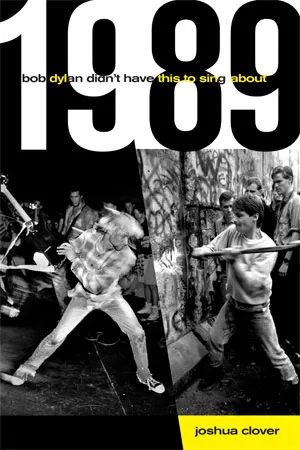
1989
Joshua Clover 1989: Bob Dylan Didn’t Have This to Sing About University of California Press 198 pages, 9 x 6 inches ISBN 978 0520252554
Available here →February 24, 2010
20100224-clover-joshua-on-1989-bob-dylan-did-not-have-this-to-sing-about-3
A close-up
The rest of this thread

Joshua Clover
Joshua Clover is an Associate Professor of Poetry and Poetics at the University of California Davis. He has published two books of poetry (Madonna anno domini and The Totality for Kids), winning the Walt Whitman Prize from the Academy of American Poets and appearing in Best American Poetry three times. He wrote the introduction to The Matrix for the British Film Institute; next year, he’ll be a Fellow at the Society for the Humanities at Cornell University, working on a book about poetry and political economy.
Pull this thread
Pop around 1989 registered the disappearance of the century's organizing antagonism, and the cost was the capacity to think historically.
Know something the rest of us don't?
Most threads on Rorotoko begin with our invitation. Any thread can begin with a proposal: you write it with the same prompts every thread answers, and we review it.
Propose a thread →