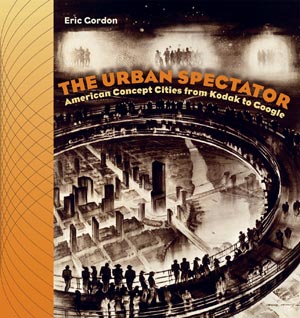
Chapter 7, on the topic of the database city, is probably my favorite chapter. In it, I examine the development in Hollywood, California known as Hollywood and Highland. This urban entertainment district is meant to be a representation of Hollywood in Hollywood. It is not simply filled with images of Hollywood’s past; instead, it functions as a platform from which to consume those images. It offers a view of the Hollywood sign from every corner, it opens up into the existing streets, and it references the city’s past without having to be explicit. The development carefully nourishes an active spectator that can assemble and reassemble the city’s references with each turn. This is the database city—a city with no content other than to grant access to content. Hollywood and Highland has adopted the formal characteristics of a database.Hollywood and Highland is a response to a new kind of spectatorship, one that I call the digital possessive. In digital culture, possession is quite literal—networked media encourage, if not mandate, the possession of thoughts, practices and memories in personal folders, accounts and devices. Think blogs, Flickr, Twitter, etc. Just as information online is assembled and ordered in digital aggregators, in Hollywood and Highland, material structures, physical spaces, narratives, imagery, and other people are assembled and ordered as an urban aggregator—a physical space built to construct a sense of possession and control over urban experience and history.While Hollywood and Highland is a spectacular example of the database city, the logic of the database and the desire for efficient aggregation is influencing much of the contemporary thinking about new urban developments. To design good urban spaces, we need to consider how technology will be used within those spaces. But the practices of digital consumption are not only changing how we interact with digital media in urban space; they are changing also what we expect from our spaces. Media practices do not end when we turn away from the screen – they continue into other aspects of our lives by transferring expectations of usability from the screen to the urban environment.My book makes an argument about the influence of media on urban design and culture. Too often, cities are designed without considering how people actually experience them. The nature of spectatorship, how it is constructed through media practices, is absolutely essential for designing good cities.Digital media is already altering the urban landscape. GPS-enabled smart phones, for instance, are making it possible for one’s physical location to factor into their web searches. So whether or not architects and planners are paying attention, the digital possessive will be formative of American urbanism in the foreseeable future.The real challenge will be in the more subtle changes that the digital possessive implies. Spectatorship is not only the result of direct interaction with technology. In most cases, technology has served primarily as a structuring metaphor for urban looking. The digital possessive will begin to alter how spectators interact with each other, with or without network connection. It will begin to alter how they interact with the built environment, with or without technology. It is imperative for designers, planners, and architects not to mistake spectatorship for the technology that helps shape it. Spectatorship is culture; and the way we design and inhabit cities is a direct reflection of that culture.The Urban Spectator is about the 20th Century American city. But as more and more people move into cities throughout the 21st century, the experiences born of them will be even more influential on the way we live and on shaping the values that guide our lives.