
Laura Skandera Trombley
Mark Twain’s Other Woman
The beginning of Chapter Two sets the stage for understanding what an unusual position Twain occupied at the end of his life.Due to his longevity, Twain had almost become a lost figure, caught between the nineteenth and twentieth centuries—comfortable in neither. This tension contributed to the stresses and strains that surfaced in his family. Born two months prematurely on November 30, 1835, Twain’s birthplace was the hamlet of Florida, Missouri, located at the fork of the Salt River. Red-haired Samuel Langhorne Clemens arrived to his parents in a tiny two-bedroom, rented cabin with an outdoor lean-to kitchen.
By the fall of 1905, at age sixty-nine, he had become a wealthy resident of lower Manhattan, New York City.
New York City in 1905 boasted the world’s busiest harbor, the biggest ships and longest bridges, the worst slums and overwhelming prosperity. There were elevated trains that crossed rivers and twenty miles of newly completed New York subway with the fare costing just a nickel. Traffic was thick with people, pushcarts, horses, cars and trolleys all jostling for a place in the crowded streets.
The largest conglomeration of millionaires in history, who had accumulated gigantic tax-free fortunes, lived in massive homes on tree-lined boulevards. An enormous wave of immigrants from Eastern Europe and Italy was passing through Ellis Island, changing the city’s ethnic make-up and culture and creating tremendous social and political stresses. New York was the largest Jewish city in the world, the largest Irish city, one of the largest German cities, and home to more than 700,000 Russians.
This was Mark Twain’s city and he was its most celebrated citizen, popularly recognized as the “Belle of New York.”Twain belonged to the world and was the first global celebrity. On December 6, 1905 he celebrated his seventieth birthday at Delmonico’s Restaurant with 170 of his friends and fellow writers. President Theodore Roosevelt sent a speech to be read in his absence, pointing out that Twain “is one of the citizens whom all Americans should delight to honor, for he has rendered a great and peculiar service to America, and his writings, though such as no one but an American could have written, yet emphatically come within that small list which are written for no particular country, but for all countries, and which are not merely written for the time being, but have an abiding and permanent value.” After a banquet lasting five hours, with fifteen speeches given and nine poems read, those in attendance were given a foot-high plaster bust of the honoree. By the close of the evening, there were 171 Mark Twains in the room.
This unschooled son of Missouri had become as big as New York City.My ambition for this biography is to encourage a reappraisal of Mark Twain in this centennial year of his death. For too long, the public version of Twain has been the image of a calcified, genteel, white statue that apparently was free of the worries that constitute the human condition. In fact, Twain was utterly human in his struggles as a spouse and parent. At the end of his life, he gave free rein to his feelings of rage and inadequacy, and in his frantic efforts to establish his legacy he reveals his narcissism and insecurity.
If anything, Twain’s literary genius lay in his ability to sublimely capture our common humanity and make us realize that even in the midst of horrendous social evils, it was possible for an unschooled, poor, southern boy to do the right thing when it came to protecting Jim, the only adult who had ever treated him with kindness.
It is time to make Twain human again. The purpose of Mark Twain’s Other Woman is to lift the layers of what has come to be accepted as truth about Mark Twain’s life and to explore what actually existed in the beginning and what finally remained at the end.
Editor: Erind Pajo
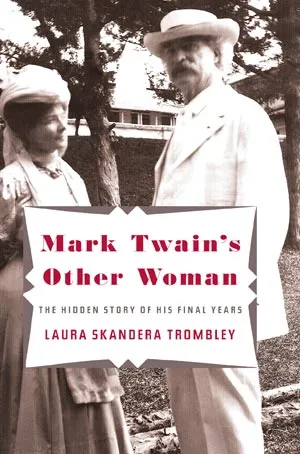
Mark Twain’s Other Woman
Laura Skandera Trombley Mark Twain’s Other Woman: The Hidden Story of His Final Years Alfred A. Knopf352 pages, 9 ¼ x 6 ¼ inches ISBN 978 0307273444
Available here →March 15, 2010
20100315-trombley-laura-on-mark-twain-other-woman-hidden-story-final-years-3
A close-up
The rest of this thread

Laura Skandera Trombley
Laura Skandera Trombley is the President of Pitzer College. She did her Ph.D. in English at the University of Southern California. Besides Mark Twain’s Other Woman, featured in her Rorotoko book interview, she is the author of Mark Twain in the Company of Women, co-editor of Constructing Mark Twain, and editor and co-editor of two other books.
Pull this thread
The genial, wisecracking Twain of his last years is a fiction Twain engineered himself.
Know something the rest of us don't?
Most threads on Rorotoko begin with our invitation. Any thread can begin with a proposal: you write it with the same prompts every thread answers, and we review it.
Propose a thread →