
Laurie Maguire
Helen of Troy
No one can write about Helen of Troy without thinking about the meaning of beauty.
Consider the following statements about Helen’s beauty. Here is Guido delle Colonne writing in the thirteenth century: “Helen was famous for excessive loveliness.” Guido’s phrasing is interesting: Helen is not the most beautiful woman in the world (that would be a compliment: Helen as the absolute of womankind); she is a woman with too much beauty (a hint of a problem: that in this case surplus is deficiency).
Here is the Renaissance writer Giovanni Petro Bellori, arguing that Helen did not have enough beauty: “Helen was not as beautiful as they pretended, for she was found to have defects and shortcomings.” Here is the New York Times film critic reacting to Diane Kruger’s portrayal of Helen in the Hollywood film Troy: “she isn’t sufficiently fabulous-looking to be convincing as the face that launched a thousand ships.”
Common to these statements is an economy of surplus and lack: Helen’s beauty is “excessive” or “insufficient.”
These binaries are attributed to beauty but they are also, as it happens, properties of narrative. Plenitude and lack are common to both, and the result is the same: desire. In life we call it longing; in narrative it is called suspense.
In Shakespeare’s Antony and Cleopatra Enobarbus attempts to describe ancient Egypt’s most beautiful ruler, Cleopatra. Although he can describe everything around her in sumptuous and erotic detail, when it comes to Cleopatra herself he summarizes simply: “she makes hungry / Where most she satisfies.”
What is true of Cleopatra is true of Helen and is true of narrative itself: it makes hungry where most it satisfies.
Narrative detail is the literary equivalent of the dermatological itch, where one scratch of inflamed skin is too many and one hundred is never enough. Any attempt at literary representation of beauty invites detail (was she blonde? tall? what color were her eyes?) and all details about Helen prove problematic, for reasons related to the binary sketched above. As Susan Stewart put it, in On Longing, “detail . . . does not tell us enough and yet it tells us too much.”
Thus beauty, like its linguistic proxy, detail, paradoxically creates the one thing it tries to forestall: the longing for more. Of all other desires—a good meal, a new car, a bigger house—the fulfillment of the desire coincides with the termination of longing. As Elaine Scarry argued, when the object is acquired or the dream realized, desire ends; beauty, however, renews the longing.
In this sense, the specific narrative problem of detail is a problem of closure. For in attempting to describe and to detail, narrative tries to pin down and to contain. Detail is really an attempt at closure.
The history of Helen’s story is a series of attempts to close that story, a closure Helen and her narrative consistently elude and frustrate. Closure is something that beauty, not just Helen’s beauty, resists.
What happens when a story is translated—literally, “carried across”—or updated to modern political and cultural conditions?
The rape of Helen was clearly topical in the 1590s when poems and plays about Helen (including several allusions by Shakespeare) abound. These literary retellings of Helen’s story coincide with a change in rape law: in 1597 a statute change made rape a crime against the woman rather than against the male “owner” of the woman (her husband or father).
But what happens when Helen changes ethnicity? (Derek Walcott gives us the first black Helen in his 1997 Caribbean Omeros.) What happens when Helen’s story gets rewritten to whitewash her? (Virginia Woolf’s Clarissa Dalloway is presented as a latter-day Helen, one who never succumbed to temptation.) What happens when the story foregrounds Helen’s motherhood? (A Victorian novel does this, A Daughter of the Gods, by the unknown female writer, Jane Stanley.) Or when Helen’s story becomes the subject of comedy and parody (as in Offenbach’s operetta La Belle Hélène) or a silent movie (Helen of Troy won an Oscar for its witty intertitles in the first year of the Oscars, 1928)?
Getting to know a story helps us get to know the period that told it.
Editor: Erind Pajo
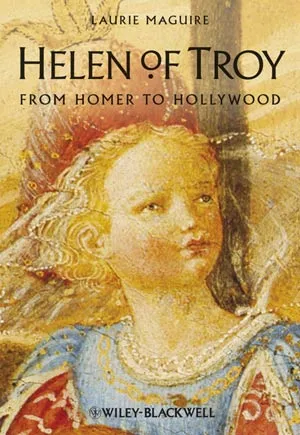
Helen of Troy
Laurie Maguire Helen of Troy: From Homer to Hollywood Wiley-Blackwell 280 pages, 9 x 6 inches ISBN 978 1405126359
Available here →March 17, 2010
20100317-maguire-laurie-on-helen-of-troy-from-homer-to-hollywood-3
A close-up
The rest of this thread

Clark Wiseman, Studio 8
Laurie Maguire
Laurie Maguire is Professor of English at the University of Oxford and Tutorial Fellow of Magdalen College. She is the author or editor of seven books, including Where there’s a Will there’s a Way; or All I Really Need to Know I Learned from Shakespeare (Penguin 2006) and Studying Shakespeare (Wiley 2004). She reviews theater for the Times Literary Supplement and has been a judge on the Laurence Olivier theater awards panel.
Pull this thread
Helen's absence from the story she sets in motion is her essence, and every retelling attempts a closure beauty refuses.
Know something the rest of us don't?
Most threads on Rorotoko begin with our invitation. Any thread can begin with a proposal: you write it with the same prompts every thread answers, and we review it.
Propose a thread →