
Giorgio Bertellini
Italy in Early American Cinema
If someone were to flip casually through the pages of the book, I would hope that they would appreciate, and be intrigued by, its variety of illustrations.
Of course I do not expect these images to convey per se the trajectory of my argument. Yet, even when starting from the end—that’s how I flip through books, anyway—my hope is that the casual reader would formulate hypotheses about what could possibly link film frames from immigrant melodramas, Griffith’s Civil War film In The Border States (1910), and such travelogues as Picturesque Colorado (1910), with popular prints from Harper’s Weekly (1875) or the bestselling volumes of Picturesque America (1874), old photographs by Riis, Stieglitz, Watkins, Hine, von Gloeden, and Sommer, and even older paintings by Cole, Gilpin, Volaire, Rosa, and Lorrain. I would hope that the book’s front and back covers, not to mention its rich filmography, could similarly prompt the reader to want to read (or just flip through the pages) more.
Italy in Early American Cinema seeks to place the question of race at the center of our discussions on how early American cinema became a national, mass entertainment. One of the goals of this study is to stimulate a treatment of race as visual form, at once aesthetically and commercially effective, and not just as films’ subject matter. More work certainly ought to be done in this direction to verify, articulate, and broaden the validity of my racially based intermedial hypothesis. For instance, one could examine broader samples of films, photographs, and other visual materials, particularly with regard to racial groups I have not systematically discussed, such as Irish, Slavs, Latinos, and Asians-Americans. One could also pair picturesque characterizations with another major vector of racial identification: physiognomy. If picturesque representations kept figures in the middle ground or background, physiognomy brought them most forcibly to the foreground, into an extreme and most expressive “close-up.”
Linked to the book’s specific argument is also a methodological reframing associated with the question of modernity. I devote the Afterword to this. Motion pictures emerged at a historical juncture that did not just feature technological and industrial innovations and their impact on everyday (urban) life, but also involved transatlantic migrations, nationalist ideologies, and imperialistic formulations of racial difference, as well as their ingrained traditions of visual representation.
When examined through the lens of racialized representations and receptions, studies of early cinema may profitably complicate medium-specific textual analyses, with their penchant for closely defined time frames. A historiographical consideration of larger geopolitical occurrences, from colonialism to imperialism, nationalism to migrations, and their related scientific rationalizations (i.e. anthropology, ethnography, and urban sociology) does not abolish textual analysis. On the contrary, it reveals films’ expressive, ideological, and commercial debts to a host of other representational practices, from paintings, theater, literature, and illustrated prints to caricatures, lantern slides, and photography.
This broader approach ultimately reveals a dynamic, centuries-old network of intermedial representations which constituted the lively, and equally modern, terrain that defined an aesthetic of racial difference and which, at the turn of the twentieth century, cinema furthered, expanded, and popularized in a unique fashion.
The discipline of cinema studies has been very fond of a formulation of modernity neatly positioned at the end of the nineteenth century and fittingly coinciding with the emergence of cinema. When it comes to national and racial discourses, however, a longer dureé of the category of the Modern, one for instance adopted by the discipline of history, may expand even further the interdisciplinary heuristics of early cinema history.
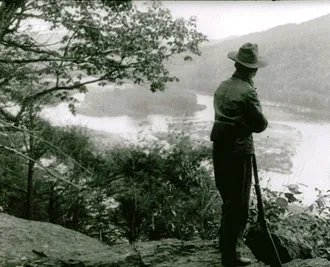
The picturesque view from a hilltop makes it a coveted guard post in Griffith’s In the Border States. Biograph, 1910. (Courtesy of the Library of Congress, Motion Picture, Broadcasting, and Recorded Sound Division.)
Editor: Erind Pajo
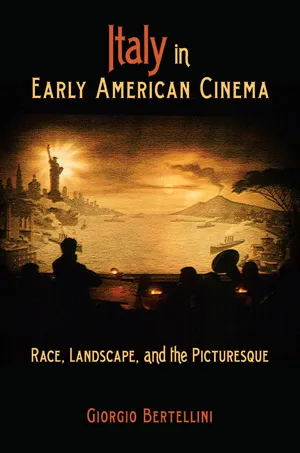
Italy in Early American Cinema
Giorgio Bertellini Italy in Early American Cinema: Race, Landscape, and the Picturesque Indiana University Press 464 pages, 9 x 6 inches ISBN 978 0253221285 ISBN 978 0253353726
Available here →March 24, 2010
20100324-bertellini-giorgio-italy-american-cinema-race-landscape-picturesqu-3
A close-up
The rest of this thread

Jacqueline Reich
Giorgio Bertellini
Educated in philosophy in Milan and Cinema Studies in New York, Giorgio Bertellini is Assistant Professor in Screen Arts and Cultures and Romance Languages and Literatures at the University of Michigan. Author of a monograph on Bosnian director Emir Kusturica, he has published numerous essays on ideas of race, nation, and geography in film aesthetics in two dozen anthologies and in several journals. Editor and co-editor of anthologies on silent film and Italian cinema, he is currently editing Silent Italian Cinema: A Reader and working on another book on the 1920s rise to fame of Valentino and Mussolini in the US and Argentina.
Pull this thread
Early American cinema's handling of race ran on the Picturesque, inherited from painting, prints and photography.
Know something the rest of us don't?
Most threads on Rorotoko begin with our invitation. Any thread can begin with a proposal: you write it with the same prompts every thread answers, and we review it.
Propose a thread →