
Mark Swislocki
Culinary Nostalgia
One very important point I try to make in my book is that the Communist Party did not set out to destroy Chinese food, as many Western visitors to China concluded in the 1970s, when the country began receiving visitors from outside the socialist world, and when the food was, indeed, often terrible.
There is no denying that the party was deeply troubled by the political and moral economy of Shanghai’s pre-1949 food culture: by the presence of beggars and orphans starving in the street outside of extravagant restaurants; by apparent links among restaurants, seedy cabarets, crime lords, and brothels; and even by the possibility that that restaurants might become dens of counterrevolutionary activity.It is also clear that, in its efforts to nationalize the food supply and the service industry, the Party introduced new kinds of inefficiencies that led to massive food shortages and distribution problems, especially in the case of the deadly famine following the Great Leap Forward.
Indeed, there is little evidence of nostalgia for the food prepared in communal kitchens or government owned restaurants, and the anecdotal evidence of bad service in those restaurants is overwhelmingly convincing.But alongside this history of bad food, hunger, and surly waiters, I also found ample evidence of a political party deeply concerned with the deterioration of the quality of cuisine. Government units thus established cooking schools to train new generations of chefs. Officials in these units wrote glowingly of chef talents in chef personnel files.
Party representatives, moreover, supported, and even prided themselves on supporting, local initiatives to restore cultivation of local special crops, such as the Shanghai honey nectar peach. Party officials even sought to ennoble the cooking profession, so that chefs, who historically occupied a low social status, might enjoy the same social recognition as the food they prepared.
Few passages of my book better illustrate the investment of Communist Party authorities in saving Chinese cuisine than the brief section (page 209) on the remarkable “memory discussion sessions,” which Party officials conducted with professional chefs from the neighborhood of the City God Temple, long home to some of the city’s most famous and popular local snack foods.
Authorities in Shanghai had recently become aware that many of the city’s most treasured specialty snack foods were no longer being served, and also that the city’s corps of professional chefs was aging.
These memory discussion sessions gathered together the leading chefs of the City God Temple neighborhood, so that through dialogue, mutual memory stimulation, and exchange, they might be able to remember collectively how to cook the specialty foodstuffs that had faded from the marketplace, and also help guarantee that the recipes would be passed on to a younger generation of chefs. Readers familiar with the wider history of such memory sessions will be struck by the difference from their conventional uses, which more typically involved inciting peasants to criticize the past abuses of their landlords, or pressuring participants into remembering and disclosing the life histories and past social relationships of alleged counterrevolutionaries.
Revolution, as the saying puts it, was not a dinner party, but the Communist Party wasn’t necessarily opposed either to cuisine or to celebrating cuisine as a key aspect of China’s cultural heritage.Aside from inviting readers to take food and nostalgia seriously, I think that there might be a kind of mirror in Shanghai’s historical record for the evolving set of broader concerns about the state of the world food supply today. The stridently “localist” impulse that animates practices ranging from the Slow Food Movement to the rise of community supported agriculture is not unprecedented. Those who deride localism as elitist or “nostalgic” in the worst sense of the word would thus do well to listen more carefully to what that nostalgia is saying about what people want to eat and why.
The tenacity of regional food culture in China meant that nobody ever seriously considered the possibility of creating a national cuisine, let alone considered that doing so might be desirable. It may be that food just doesn’t lend itself, ultimately, to such a product. The last century and a half of food processing and industrialization has, of course, facilitated the spread of foods across regional boundaries, so that Americans can, if they wish, all eat the same condiments, canned goods, and prepared foods. But the backlash, however long in coming, may be telling us that the attempt to nationalize cuisine, rather than culinary nostalgia, is the true pathology in the history of food.
Editor: Erind Pajo
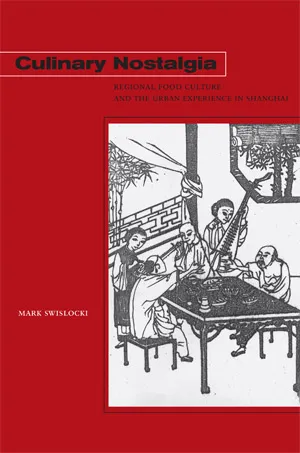
Culinary Nostalgia
Mark Swislocki Culinary Nostalgia: Regional Food Culture and the Urban Experience in Shanghai Stanford University Press320 pages, 9 x 6 inches ISBN 978 0804760126
Available here →April 2, 2010
20100402-swislocki-mark-on-culinary-nostalgia-regional-food-shanghai-urban-3
A close-up
The rest of this thread

Maya Allison
Mark Swislocki
Mark Swislocki is Assistant Professor of History at Brown University. He received his Ph.D. in History from Stanford University and specializes in the cultural history of China. He is currently involved in research on the history of animals and natural history.
Pull this thread
Nostalgia is a category for critical reflection, and Shanghai's regional foodways are an objection to modernity.
Know something the rest of us don't?
Most threads on Rorotoko begin with our invitation. Any thread can begin with a proposal: you write it with the same prompts every thread answers, and we review it.
Propose a thread →