
Timothy Morton
The Ecological Thought
If I were yelling at someone from a fast moving train and had only one chance to say one thing about my book before they went out of earshot, I suppose it would be the stuff at the end. The concepts that lead up to this point are interesting, of course—“the mesh,” which is what I call ecological entanglement, and the “strange stranger,” which is how I think about life forms.
But the real juice of the book would have to be the writing about how important it is to create a politics and an ethics based on non-self.
We modern humans have given rise to the most terrifying things like global warming and plutonium—I call them hyperobjects. These monsters massively outlive us and vastly extend beyond our personal backyard to encircle the entire Earth. There is no way you can think of them without your mind opening up. Plutonium has a half-life of 24,100 years. That means we have a 24,100-year responsibility to the future. However you think of it, everyone, anyone you meaningfully care about as connected to so-called “you” will be long gone by then—will there even be humans? Twenty-four thousand years is twice as long as all of recorded human history thus far.
Likewise global warming is mind-bending. Unlike snow, you can’t see it or touch it; this gives global warming deniers a foot in the door. But the kicker is, it’s much more real, in a very precise sense, than a snow shower. It’s the snowfall that becomes the abstraction! Weather is an abstract subset of climate. It’s just what you think you can feel falling on your head in a certain time at a certain place. This is why the fiercest battles are fought over global warming right now. Right wingers know that if they give this idea a sliver of a chance, they literally don’t have a leg to stand on. Because reality isn’t hardwired their way. It’s a whole, dynamic process in which we are all implicated and for which we all have responsibility. Who cares whether we caused global warming or not? If you can understand what it is, you have a responsibility to fix it. It’s like seeing a small girl about to be hit by a truck. Saying “Well she’s not my daughter, why should I care?” would clearly be wrong. You just jump into the street and save her.
We urgently need to formulate reasons for doing things that aren’t based on concepts of self, because even if we modify those concepts to include as many others as possible, we’ll always leave someone out. And gamma rays don’t leave anyone out—hyperobjects are pretty inclusive beasts. Our philosophy has to be at least as inclusive as they are to stand a chance of dealing with them.
I think the whole project of The Ecological Thought itself is a kind of “” type of a project. If you don’t think that there’s something very wrong with Earth and with our ways of thinking about our place on Earth, then—well you just proved that there is truly something wrong!
Editor: Erind Pajo
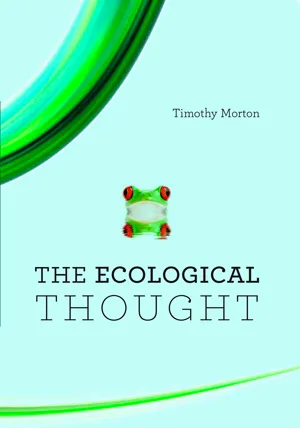
The Ecological Thought
Timothy Morton The Ecological Thought Harvard University Press 184 pages, ISBN 978 0674049208
Available here →April 30, 2010
20100430-morton-timothy-on-the-ecological-thought-3
A close-up
The rest of this thread
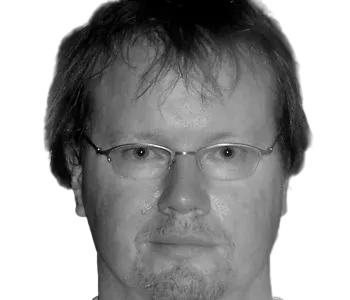
Timothy Morton
Timothy Morton is Professor of English (Literature and the Environment) at the University of California, Davis. He is the author of nine books and over sixty essays on ecology, philosophy, culture, literature, and food. He writes at ecologywithoutnature and contemporarycondition.
Pull this thread
The concept of nature has had its day and is now an obstacle.
Know something the rest of us don't?
Most threads on Rorotoko begin with our invitation. Any thread can begin with a proposal: you write it with the same prompts every thread answers, and we review it.
Propose a thread →