
Seth Lerer
Children’s Literature
I first became interested in the history of children’s literature when I was working on the writings of Geoffrey Chaucer. Chaucer was viewed as the “father of English Literature,” and he was also viewed by his later readers of the fifteenth and sixteenth century as a writer with educational content.
I thus became aware of literary history itself as a kind of family romance—if there was a father of literature, who where the children? I also became aware of Chaucer’s literary “fatherhood” as granting a particular authority—he could be read as a kind of fatherly figure teaching children.
These scholarly concerns dovetailed with my own, personal experience of child-rearing and reading to my son, Aaron, so that after a while I became both professionally and personally concerned with the history of education and the rise of childhood literacy.
Among the general principles guiding the book, therefore, some are critical, some are social, and some are personal.
The critical principles are that, while authors may intend a particular meaning for literary works, meaning is made by or brought to literary works by readers. The meaning of a literary work in a culture is, in many ways, the sum of the traditions of reading it over time. Thus, we come to Chaucer, or Shakespeare, or Toni Morrison, or Jane Austen through the filter of generations of teachers and critics, of popular cultural adaptations, and of our own tastes and presuppositions. Children’s literature, I argue, works in these ways.
The social principles behind my work involve a view of reading (especially reading in groups) as an ethical practice. Reading to and with children is a form of familial bonding. Communities of reading—shaped by schools, public libraries, book groups, and the like—build social networks. Many works of children’s literature take as their very theme the making of a literate child, and many works often have scenes of reading and writing as moments of growth and revelation in their narrative.
My personal principles lie in a conviction that, whatever the rise of digital technology in society, the physical, bound book remains a unique artifact. Our experience of reading bound books is different from our experience of reading on a screen (however book-like). Thus, I am concerned with the physical, bodily experience of reading and writing, and the ways in which children’s books themselves become talismans of identity for children as they grow up.
Editor: Erind Pajo
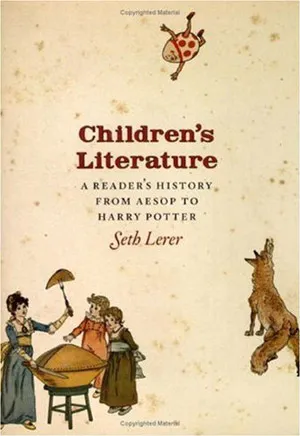
Children’s Literature
Seth Lerer Children’s Literature: A Reader’s History from Aesop to Harry Potter University of Chicago Press 400 pages, 9 x 6 inches ISBN 978 0226473017
Available here →May 17, 2010
20100517-lerer-seth-children-literature-reader-history-aesop-harry-potter-2
The wide angle
The rest of this thread

Seth Lerer
Seth Lerer is the Dean of Arts and Humanities and Distinguished Professor of Literature at UCSD. Before joining the UCSD faculty in 2009, he was the Avalon Foundation Professor of Humanities at Stanford. Lerer was born in Brooklyn, New York, and educated at Wesleyan, Oxford, and the University of Chicago. Children’s Literature, featured in his Rorotoko interview, won the National Book Critics Award in Criticism in for 2008 and the Truman Capote Award in Literary Criticism in 2010. Lerer is also the author or editor of numerous other books—including Chaucer and His Readers, Error and the Academic Self, Inventing English—and articles and reviews in the fields of medieval literature and the history of scholarship. He is well known, too, for his public lectures on language and culture and his Teaching Company lecture series, The History of the English Language. Throughout his scholarship and teaching, Lerer focuses on the ways in which we see the world through language, and how reading, schooling, and political debate foster a literate imagination.
Pull this thread
Children's literature is whatever children read, which makes Homer, Shakespeare and Twain children's writers.
Know something the rest of us don't?
Most threads on Rorotoko begin with our invitation. Any thread can begin with a proposal: you write it with the same prompts every thread answers, and we review it.
Propose a thread →