
Howard Gillette Jr.
Civitas by Design
I am particularly intrigued with the story of public housing, where one would least expect to encounter “communities of citizens.”
The early history of the movement to provide decent shelter at affordable prices reveals, however, the same high intention of creating physical means for enhancing social ties among residents, such as common recreational and use facilities. The hostility to such amenities and their presumed costs led to their elimination, and public housing became over time the last refuge of those who could least afford better options in the private market.
When the Department of Housing and Urban Development adopted New Urbanist design guidelines under its Hope VI program in the 1990s, the gap between public and private housing narrowed. Despite this apparently successful marriage between social uplift and good design, however, such successes have been infrequent in the private sector.
One example, pictured on the book’s cover, in calculated relationship to the best example of garden city design in America (Radburn, New Jersey), is the Ethel Lawrence Homes in Mount Laurel, New Jersey. Open to residents whose incomes fall between 20 and 80% of median income, the Lawrence facility is every bit as inviting physically as the best private developments in the region. Such examples remain the exception, however.
Civitas by Design went to press as the country entered one of its worst recessions. It was obvious that, even with a new president steeped in progressive values and associated with community work, the persistent problems of our most devastated post-industrial cities were not going to receive immediate priority. Crisis management rather than long-term reform has been the primary concern of the early Obama administration.
That being said, I still have hope that design precedents that fully incorporate a commitment to social justice can once again be utilized in a variety of circumstances. The history of interventions to upgrade physical conditions with hopes of strengthening our civic life offer both precedents and lessons for improvement. We have the information to extend these efforts. We need only the will to act.
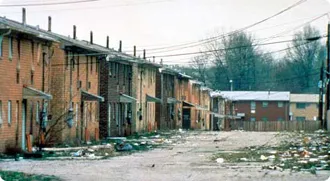
Park Duvall public housing complex in Louisville before conversion in accordance with New Urbanist design. Photographs courtesy of Urban Design Associates, Pittsburgh.
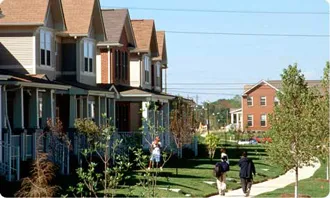
Park Duvall public housing complex in Louisville after conversion in accordance with New Urbanist design. Photographs courtesy of Urban Design Associates, Pittsburgh.
Editor: Erind Pajo
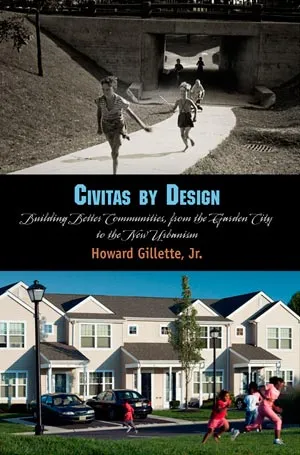
Civitas by Design
Howard Gillette Civitas by Design: Building Better Communities, from the Garden City to the New Urbanism University of Pennsylvania Press 216 pages, 9 x 6 inches ISBN 978 0812242478
Available here →July 12, 2010
20100712-gillette-howard-civitas-by-design-build-communities-new-urbanism-3
A close-up
The rest of this thread

Howard Gillette Jr.
Howard Gillette, Jr. is Professor of History at the Camden campus of Rutgers University. Besides Civitas by Design, featured in his Rorotoko interview, he is also the author of Between Justice and Beauty: Race, Planning, and the Failure of Urban Policy in Washington, D.C. and Camden after the Fall: Decline and Renewal in a Post-Industrial City (both available in paperback from the University of Pennsylvania Press) as well as other work. Gillette is a past president of the Society for American City and Regional Planning History and director of the Mid-Atlantic Regional Center for the Humanities. His recent work has included efforts to craft an interpretive plan for the Bethlehem Steel site in Pennsylvania and the creation of a community-based encyclopedia of Greater Philadelphia.
Pull this thread
A century of American planning tried to manufacture civic community out of physical design, and the designs proved insufficient.
Know something the rest of us don't?
Most threads on Rorotoko begin with our invitation. Any thread can begin with a proposal: you write it with the same prompts every thread answers, and we review it.
Propose a thread →