
Larry Wolff
The Idea of Galicia
A fascinating cast of characters populate the pages of the book—individuals who contributed to shaping the idea of Galicia over the course of two centuries.I write about Habsburg emperors like Joseph II, who sought to bring about a messianic transformation of Galicia in the 1780s, and undertook, for instance, the reform and recasting of its Jewish population—who received last names from the emperor.
Or like Franz Joseph, who, ruling for almost 70 years (from 1848 to 1916), became a semi-mythological figure in his own lifetime, and was then fully mythologized in literature and fantasy after his death.I hope my readers will notice the Galician experiences and perspectives of Mozart’s son, Franz Xaver Wolfgang Mozart, who decided that he would rather pursue his musical career as a composer in Galicia instead of in Vienna under the shadow of his father’s legendary genius.No less intriguing are such Galician writers as Leopold von Sacher-Masoch, who wrote the notorious novella Venus in Furs about Galicia, and later left his name to the sexual temperament of masochism.
Or Karl Emil Franzos, the author of Halb-Asien, who fictionalized the world of the Galician Jews. Or the greatest comic dramatist of Polish literature, Alexander Fredro, who built his comedies upon the tensions and contradictions of Galician life. Or the great Ukrainian writer. Ivan Franko, who wrote about the Galician oil fields in his novella Boa Constrictor.
There were also great 20th-century Galician writers who wrote about Galicia after the province ceased to exist. Joseph Roth, Bruno Schulz, and Shmuel Yosef Agnon, all born in Galicia, survived the abolition of their native province and later became great writers in the German, Polish, and Hebrew languages respectively, thus illustrating the cultural complexity of Galicia.
One random thing I’d like my readers to notice is the brief discussion of Billy Wilder, the great Hollywood genius of cinema, who was actually born in Galicia.
I hope readers will take away a sense of the “evolutionary” history of geopolitical forms.In the course of history, a province like Galicia can suddenly be created, evolve for more than a century, accumulate meanings and associations on the map of Europe, then lapse into extinction—and yet not be altogether forgotten, still playing a phantom role in the historical developments that follow.
In Eastern Europe we have seen radical changes on the map since the end of the Cold War, the disintegration of some countries, the emergence of others, a division and subdivision of former geopolitical spaces. All this serves as a reminder that the map of Europe, as we see it at any given moment, represents the contingent reshuffling of many different forms that have appeared and disappeared over centuries.
Mapping is intellectual and cultural work, and every geopolitical space may also be represented by ideas and identities, which may survive in consciousness and memory even after the space itself vanishes from the map. I hope that this book will unsettle and reshape readers’ sense of the Habsburg Empire, what it signified when it existed, and how— in fantasy and history—it continues to haunt and complicate the countries that have replaced it on the map.
I hope readers will take away a particular sense of how powerful is the role of fantasy (as, for instance, in the fictions of Sacher-Masoch) for shaping especially perspectives on Eastern Europe.
Finally, I hope that Americans whose families emigrated from Galicia more than a hundred years ago will take away from the book a sense of the complexity of the province that no longer exists, but that powerfully shaped the affiliations and identities of their grandfathers and grandmothers.
Editor: Erind Pajo
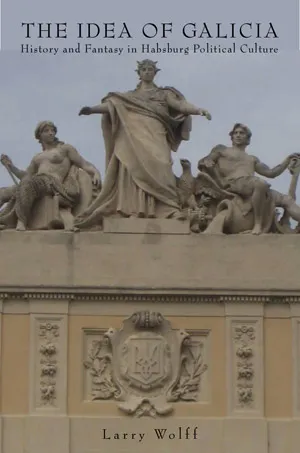
The Idea of Galicia
Larry Wolff The Idea of Galicia: History and Fantasy in Habsburg Political Culture Stanford University Press 504 pages, 9 x 6 inches ISBN 978 0804762670
Available here →August 16, 2010
20100816-wolff-larry-idea-galicia-history-fantasy-habsburg-politic-culture-3
A close-up
The rest of this thread

Larry Wolff
Larry Wolff is Julius Silver Professor of History at New York University and director of the NYU Center for European and Mediterranean Studies. He received his A.B. from Harvard and his Ph.D. from Stanford. Besides The Singing Turk, featured in his recent Rorotoko interview, and The Idea of Galicia: History and Fantasy in Habsburg Political Culture, featured in an earlier Rorotoko interview, his books include Paolina's Innocence: Child Abuse in Casanova's Venice (2012), Venice and the Slavs: The Discovery of Dalmatia in the Age of Enlightenment (2001), Inventing Eastern Europe: The Map of Civilization on the Mind of the Enlightenment (1994), The Vatican and Poland in the Age of the Partitions (1988), and Postcards from the End of the World: Child Abuse in Freud’s Vienna (1988). Larry Wolff has received Fulbright, American Council of Learned Societies, and Guggenheim fellowships, and in 2003 was elected to the American Academy of Arts and Sciences.
Pull this thread
Galicia was an invented place that became real to the people who lived there.
Know something the rest of us don't?
Most threads on Rorotoko begin with our invitation. Any thread can begin with a proposal: you write it with the same prompts every thread answers, and we review it.
Propose a thread →