
Federico Finchelstein
Transatlantic Fascism
Fascism was a cross-regional civic religion in its most extreme form. In certain Catholic countries fascism reoccupied places previously held by institutional religion but also let itself be invested by the “sacred.”
This intertwining of the secular with the sacred is central to an understanding of Argentine fascism and is thoroughly explored in the book. I stress the complex interaction between secularizing processes and religious tradition and practice. The book focuses on the quasi-religious dimensions of fascism that complexly overlapped with the Catholic “sacred.”
This relation was not devoid of conflicts. But antisemitism, and with it anticommunism, provided both fascists and Catholics on the far right with a common intellectual battlefield on which to join forces as well as a symbolic shared space for enacting fascist ideology.
As a political religion, Argentine fascism was embedded in Catholicism, as the fascists understood it. In this context they resorted to antisemitism as the best metaphor to represent the internal enemy.
Editor: Erind Pajo
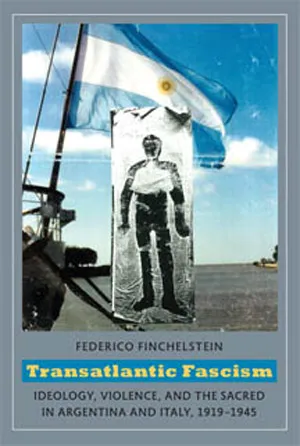
Transatlantic Fascism
Federico Finchelstein Transatlantic Fascism: Ideology, Violence, and the Sacred in Argentina and Italy, 1919-1945 Duke University Press 344 pages, 9 x 6 inches ISBN 978 0822346128
Available here →October 18, 2010
20101018-federico-finchelstein-transatlantic-fascism-ideolog-argentin-italy-2
The wide angle
The rest of this thread

Federico Finchelstein
Federico Finchelstein is Associate Professor of History at the New School for Social Research and the Eugene Lang College of the New School University in New York City, and also the Director of the Janey Program in Latin American Studies. He received his Ph.D. from Cornell University, and previously taught at Brown University. Finchelstein is the author of four books on fascism, the Holocaust, and Jewish history in Latin America and Europe, as well as more than fifty academic articles and reviews in English, Spanish, French, Portuguese and Italian. Transatlantic Fascism, featured in his Rorotoko interview, was recently published in a Spanish translation in Argentina (Buenos Aires: Fondo de Cultura Económica, 2010).
Pull this thread
pulls againstpulls alongside
Fascism was a transatlantic ideology, and Argentina's sacred Catholic version runs directly into Peronism and the 1976 dictatorship.
Against PW · The Thirty Years War was neither inevitable nor a religious conflict. On: Religion is the operative cause of religiously framed conflict
Against HR · Wounded Knee happened because control of the U.S. Senate hung on one contested South Dakota seat. On: Ideology explains state and collective violence
Against EB · Mutual-aid structure makes radical religious groups lethal, so governments should compete with them in providing benign services. On: Religion is the operative cause of religiously framed conflict
Against TH · Ordinary crime control, not ideology, was one of the decisive steps to the Bolshevik totalitarian state. On: Ideology explains state and collective violence
Alongside JS · Liberty of conscience and toleration emerge from Protestant polities by repudiating Luther and Calvin, not by fulfilling them. On: Religion is the operative cause of religiously framed conflict
Alongside DS · Dehumanization works because its victims are seen as human vermin, uncanny fusions of fellow human and subhuman creature. On: Ideology explains state and collective violence
Alongside AS · Russian revolutionary terrorism grew from deep Christian soil, and Zasulich's dream of martyrdom came from reading the Bible. On: Ideology explains state and collective violence
Alongside MF · Anglo-American policy toward the Muslim Brotherhood has run on one template since the 1940s, anointing moderates against extremists. On: Religion is the operative cause of religiously framed conflict
Know something the rest of us don't?
Most threads on Rorotoko begin with our invitation. Any thread can begin with a proposal: you write it with the same prompts every thread answers, and we read it.
Propose a thread →