
Samuel Moyn
The Last Utopia
I would probably draw my reader’s attention to a chart on p. 231 that I initially made when I got the intuition that “human rights” were far more important in the 1970s than ever before.The chart depicts the number of “hits” on the phrase human rights in the London Times and the New York Times across modern history. Before the 1940s, there is a flat line at zero. In the 1940s, there is a blip. In 1977, in both papers, there is a massive spike. In the New York Times that year, the phrase “human rights” appeared five times more frequently than in any prior year. And in neither paper did the usage of the phrase ever return to its prior levels—including the highest levels of the 1940s.When I first saw chart, I felt it pointed in the right direction, as well as opening considerable new questions.One fascinating topic this helps think about is why human rights were in decline in and through the decolonization process.After all, as Roland Burke’s excellent recent book featured on this site suggests, and my research confirms, anticolonialists at the United Nations—once their nations were admitted to vote—transformed the notion of human rights beyond the form it had taken in the 1940s. They did so by reimporting the right of self-determination that human rights had begun their career by replacing.This does not mean, of course, that human rights ever occupied the center of anticolonialist ideology in the post-World War II era. And much more important, the UN events both Burke and I chronicle failed to spark a human rights movement in the developed West.In fact, as I show in my book, an important feature of the 1970s turning point is how deeply many observers felt that human rights had to be reclaimed from their “capture” at the UN by forces who were selective and hypocritical in their eyes. This reclamation is linked to the massive spike of interest in human rights in the era.Along with the general collapse of other forms of idealism, then, human rights came home to many in the West not because of anticolonialism, but because the romance of anticolonialism was seen to have failed. It is no accident that, for Westerners, human rights are still mostly for export, mostly to the places they once ruled.Though I am a historian, I have often been asked what the present-day implications of my argument are. One, clearly, is that thinking that international human rights have been God-given or naturally occurring, or even that they were a legacy of continuous moral insight after the great catastrophe of World War II, is mistaken.Human rights make sense in a world of decolonized states, but in which not all states are trustworthy. And they were discovered by masses of people only after those people had first tried other things, and gave up on them in despair. Our idealism is one born of disappointment, not of horror or of hope.But this suggestion does not translate easily into a set of specific consequences. If I am right, even when it comes to some of the beliefs people cherish most, history shows that they are always up for grabs. They may crystallize for a while, but even then are never stable.And this also means the burden falls on the present not to turn to the past for reassurance—but to decide for itself what to believe and in what way to change the world. History at its best liberates, but does not construct.Yet perhaps there is a lesson in the history about what sort of idealism people should or at least could seek.For the longest time in modern history, programs for bettering the world mattered, especially if they were divisive. The achievement of the nation-state required dispensing with kings and aristocrats, just as the “rights of man movement” of the twentieth century that was decolonization required that empires finally end. Human rights, in the 1940s, were bypassed because they offered the mere fiction of a moral consensus that plainly did not match the need for political choice.The 1970s began an exceptional period in which the morality of human rights made sense; if and when that period ends, the need for divisive political options may once again seem the most relevant one to meet.
Editor: Erind Pajo
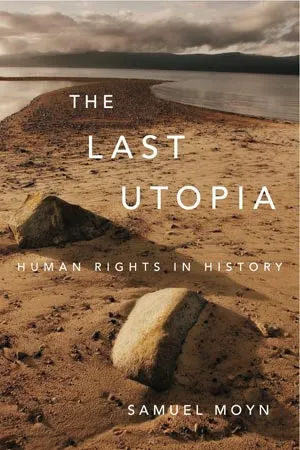
The Last Utopia
Samuel Moyn The Last Utopia: Human Rights in History Belknap Press of Harvard University Press305 pages, 5 1/2 x 8 1/4 inches ISBN 978 0674048720
Available here →October 25, 2010
20101025-moyn-samuel-on-the-last-utopia-human-rights-in-history-3
A close-up
The rest of this thread

Samuel Moyn
Samuel Moyn is professor of history at Columbia University, where he has taught since 2001. Besides The Last Utopia, featured in his Rorotoko interview, he is the author of two other books, Origins of the Other: Emmanuel Levinas Between Revelation and Ethics and A Holocaust Controversy: The Treblinka Affair in Postwar France. Samuel Moyn is also an editor of Modern Intellectual History and a founding editor of Humanity: An International Journal of Human Rights, Humanitarianism, and Development, a journal launching this fall.
Pull this thread
International human rights became a mass moral cause only in the 1970s, because earlier idealisms had failed.
Know something the rest of us don't?
Most threads on Rorotoko begin with our invitation. Any thread can begin with a proposal: you write it with the same prompts every thread answers, and we review it.
Propose a thread →