
Roger E. Backhouse
The Puzzle of Modern Economics
Modern economics emerged after the Second World War. Many crucial developments came earlier, for the 1930s was an incredibly fertile period for economic thinking. But the Second World War mobilized economists for the war effort, and after 1945 hundreds of technically trained men and women (though mostly men) went from government service into academic positions, helping to contribute to a transformation of the discipline over the next two decades.
This process was reinforced by the expansion of higher education, in which many students, including many members of the armed forces taking advantage of the GI Bill, chose to study social sciences, including economics. For many of them, the Great Depression had stimulated their desire to understand how an economy could fail so badly.
The Second World War led pretty rapidly into the Cold War—and further hot war in Korea. The result was a transformation of science funding, and economics benefited from this, as did all the social sciences.
One of the most influential sponsors of economic research was the RAND Corporation, a US Air Force think tank, where much game theory was developed. At the same time the Cold War fostered anti-communism, symbolized by Joe McCarthy’s attempt to root out communist sympathizers. The charge of “communism” could be levied against anyone arguing for significant state intervention in the economy. At the same time, there were well-funded conservative groups arguing against government intervention.
What effect did all of these have on economics?
Most economists claim that it had no effect at all. The US Air Force and the Navy put money into economic research, often not knowing what they wanted, giving economists considerable freedom to determine what they wanted to do. And whilst free-market think tanks may have influenced politicians, they will not have affected academic research.
However, it is hard to believe that there was no connection between funding and the move towards a more self-consciously “scientific” economics. In the same way that the changes in economics that took place at the end of the nineteenth century were linked to the move of economics into universities, it would be surprising that changes in the way science was funded did not affect the discipline.
Game theory and technical economics were more congenial to funding agencies than some less technical types of economics. The case with free-market think tanks is different. But it seems hard to avoid the conclusion that they contributed to a climate of opinion in which economists proposing free-market ideas found it easier to find an audience for their ideas, even if their academic colleagues were more concerned with their technical proficiency than with their policy conclusions.
None of this is to deny that economists were striving to be scientific. They were doing that. But there are many ways to do science. To explain the path that was taken we need to understand the culture in which economists were operating, and these ideological factors were a part of it. The Puzzle of Modern Economics is aimed at non-economists, or those who know a little economics. I hope these readers will take a more balanced view of economics.
Modern economics does have serious faults. But a lot of economists agree that there are problems—and they are working hard to improve economics. Their success may be limited, but a lot of economic problems are very difficult. Moreover it is often those who are firmly “inside” the profession, and who take seriously the mathematical models and other techniques that critics don’t like, who come up with most promising new ideas.
This may not sound like a startling position—but it usually gets lost in the cacophony of voices, from insiders as well as outsiders, either praising the subject or condemning it.
If the book sparked some debate among economists, there will be those economists who will think I have been far too critical and others who will think I should have been much more critical.
Economists would, I believe, be taken more seriously if they were more modest in their claims. Of course, they are not helped by a public culture that polarizes all views in the interests of generating excitement.
I would also be very happy if the book helped to promote an interest in the recent history of economics—and indeed in the recent history of the social sciences. I have, in fact, edited a book, together with Philippe Fontaine, titled The History of the Social Sciences since 1945; it is also just published by Cambridge.
Economics and the other social sciences have been an integral part of society for much of the twentieth century, yet their history is neglected. For many years, history of economic thought meant the exegesis of old books, Adam Smith or Karl Marx. This is no longer the case: serious historical work is being done on modern economics, engaging with historians, as the term is usually understood.
Only by understanding the history of the economics—taking the history seriously, not reading the potted accounts of progress that are retailed in economics textbooks—can we understand the discipline we have today.
Editor: Erind Pajo
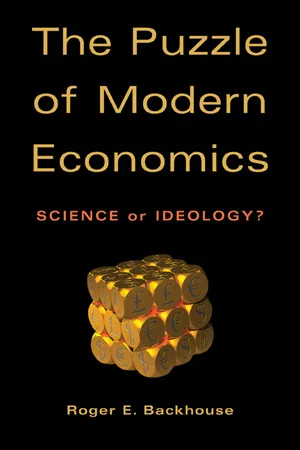
The Puzzle of Modern Economics
Roger E. Backhouse The Puzzle of Modern Economics: Science or Ideology Cambridge University Press 216 pages, 9 x 6 inches ISBN 978 0521825542 ISBN 978 0521532617
Available here →October 27, 2010
20101027-backhouse-roger-on-puzzle-modern-economics-science-ideology-3
A close-up
The rest of this thread
Roger E. Backhouse
Roger Backhouse is Professor of the History and Philosophy of Economics at the University of Birmingham, England, and has a part-time position at Erasmus University Rotterdam. He started his academic career in the 1970s, as a macroeconomist, writing theoretical articles and two intermediate macro textbooks. In the 1980s he changed direction and moved into the history of economics writing a series of books, of which The Ordinary Business of Life (Princeton University Press 2002) was aimed at general readers. Besides The Puzzle of Modern Economics, featured in his Rorotoko interview, he recently also edited, with Philippe Fontaine, The History of the Social Sciences since 1945 (Cambridge University Press 2010).
Pull this thread
Modern economics took its narrow, mathematical, market-friendly form because Cold War funding and politics selected it.
Know something the rest of us don't?
Most threads on Rorotoko begin with our invitation. Any thread can begin with a proposal: you write it with the same prompts every thread answers, and we review it.
Propose a thread →