
Jeffrey C. Alexander
The Performance of Politics
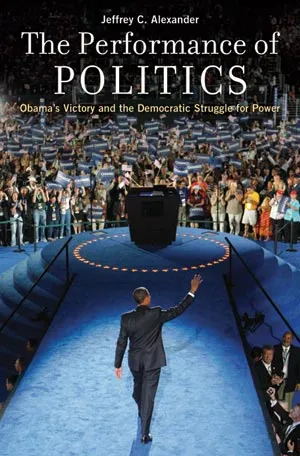
If you were to just pick up The Performance of Politics in a bookstore—perhaps attracted by the striking cover photo of Obama striding confidently to a podium in Denver to deliver his acceptance speech before a nearly delirious crowd—I’d point you to two brief sections.
One is a section called “The Hero’s Shadow” (pp. 84-87). The other is the section entitled “Celebrity Pollution” (pp. 174-176). In these two sections, you have in microcosm a discussion of narrative and symbol that define what my approach to the struggle for power is all about.
I mentioned earlier that candidates must be imagined to be world transforming heroes if they are to be elected. In these two small sections I concentrate on a surprising boomerang effect of heroic narration: the problem of hubris.
All heroes have their shadow, a negative other whose inverted attributes the bright light of their glory keeps hidden in the shade. Heroes must be modest. They cannot be seen as overreaching, as wanting to be glorious instead of simply to be good. For the Greeks, this was a matter of distinguishing heroes from gods. When heroes try to become gods, they will be destroyed. Hubris is the stuff of tragedy. It reveals a fundamental character flaw, one that triggers an action that brings the hero down from the heady heights of victory to the numbing depths of defeat.
In late July, 2008, Obama interrupted his domestic campaign to take a daring foreign policy trip that carried him from the Middle East to Europe. Speaking to adoring crowds and deferential foreign leaders, the trip seemed like a smashing success—until Steven Schmidt, McCain’s campaign director, realized that Obama might have flown too close to the sun. On the evening of July 29, McCain’s campaign places a 30-second advertisement on its website that calls out Obama as a “celebrity.” The ad goes viral and shifts the media’s narration of the campaign. For five weeks the Democratic campaign is back on its heels, and the polls show, for the first time, an almost even race.
Here is the power of metaphor! A poetic action changes the course of a campaign, responding to the potential contradictions of a narrative. Who says that only demographics, money, and organization determine the course of political campaigns?
My book illuminates the dramaturgy of the struggle for power in 2008, and candidate Obama’s success. But the model of political performance can also illuminate President Obama’s fall from grace, and the electoral “shellacking” (his words) the voters gave his party in the Congressional elections this last November, 2010.
Reading media reports about the Obama presidency, we see repeated descriptions of the lack of “connection” between President and citizens, of a lack of “excitement,” of sparse crowds, of increasingly banal speeches. These are descriptions of performative failure, of Obama’s increasing inability to symbolize.
Obama presented himself as a hero who would transform the crisis of our times. But—sadly—the economic crisis has continued, and perhaps even deepened. He presented himself as a leader who would draw enemies into negotiation and replace military force with civil power. He has, so far—again, quite sadly in my view—been able to do nothing of the kind.
As Obama’s hero stature is diminished, the power to resolve the crisis has shifted to the Republican side. His conservative challengers have succeeded in building up their own dramatic movement, one that is equally embedded in American political myths, e.g., the “Tea Party.”
It’s a time of deep crisis for the Obama character and the narrative driving his presidency. But defeat, by itself, does not unmake a hero. Even a debilitating setback can become the middle of the hero’s story, rather than the end—a new mountain for the gutsy and determined protagonist to climb. Of course, that requires that the hero climb his way back. It is up to Obama and history to decide.
Editor: Erind Pajo
The Performance of Politics
Jeffrey C. Alexander The Performance of Politics: Obama's Victory and the Democratic Struggle for Power Oxford University Press 384 pages, 9 1/4 x 6 1/2 inches ISBN 978 0199744466
Available here →December 29, 2010
20101229-jeffrey-alexander-on-performance-politics-obama-victory-democratic-3
A close-up
The rest of this thread

Jeffrey C. Alexander
Jeffrey C. Alexander is the Lillian Chavenson Saden Professor of Sociology and founder of the Center for Cultural Sociology at Yale University. Besides The Performance of Politics, featured in his Rorotoko interview, Alexander is the author of The Civil Sphere (Oxford, 2006), The Meanings of Social Life: A Cultural Sociology (Oxford 2003), Social Performances (Cambridge 2006), and Remembering the Holocaust (2009). Alexander has been called “America’s best and best-known social theorist,” his books and articles have been translated into more than a dozen languages, and in 2010 he received the Dogan Prize from the International Sociological Association.
Pull this thread
Obama won in 2008 by becoming a collective representation, not through demographics, money or organization.
Know something the rest of us don't?
Most threads on Rorotoko begin with our invitation. Any thread can begin with a proposal: you write it with the same prompts every thread answers, and we review it.
Propose a thread →