
J. E. Lendon
Song of Wrath
Mount Helicon, sacred to the muses, looked down upon the great marsh of Copaïs, graveyard of cities. In heroic times men had cleared the limestone caverns that drained Copaïs to the sea, and tilled her smiling bottomlands, and built their dwellings there. But with the passing of the heroes, and the silting of the ways, as the water carried in by the rivers Cephisus and Melas failed of escape, the cities were drowned, and Copaïs became a mere—a sea of reeds, the haunt of waterfowl, rich pasture for lowing cattle and questing pigs. To her neighbors, the Boeotians, Copaïs gave their comfortable things: herbs and rushes, plump ducks and woodcocks, and above all, tasty eels, grown fat from nibbling beneath the green-brown waters upon the inundated works of forgotten men.
Sweating porters bore the eels from the huts of their snigglers to rich fanciers as far as Athens, fifty miles to the south, to be roasted over coals in beet leaves. But nearer by far were the epicures of Thebes, lords of the Boeotian plain, their character, it is nice to think, formed over centuries by the very qualities of this writhing delicacy: strong, cunning, voracious.
This passage introduces the eel motif, which twines itself about the narrative of the book (leaving aside the literary use to which eels are put, by virtue of my Japanese childhood I’m quite addicted to unagi). I’ve also tried very hard in the book to give the modern reader a sense of place about the locations where the story unfolds, and that mission often involves descriptions of this nature or accounts of local myths (or, more exactly, what were recounted as local myths to Roman-period collectors of the same).
But the passage also represents for me a tiny, rare, but intensely gratifying, literary victory. The process of my writing runs like this. I write passages like the one above. My brother, who kindly reads all my longer work and much of my shorter, makes it even more like that—this is the process we call “bedizening.” Then most of the purple gets stripped out again by my agent, academic friends I impose upon to read the manuscript, the press’ editor and copy-editor, and my gimlet-eyed colleague and partner Elizabeth Meyer, who, when her own moral suasion fails, calls in my mother, an English teacher of the old Hemingway-admiring school.
I don’t deny for a moment that all this editing is necessary, and I am abjectly grateful for being saved from myself. But the result is that stylistically my work is usually a stricken field, the battlefield of Waterloo the day after the fighting. Very rarely can I look at a passage and say, “mine! all mine!”
The eel snigglers of Copaïs are all mine.
The reader of Song of Wrath should depart delighted by a good read, and with interest piqued in the ancient Greeks. The reader of Song of Wrath should depart excited at the prospect of reading Thucydides, the ancient master upon whose work Song of Wrath is based. And finally, the reader of Song of Wrath should depart with a new set of paradigms for understanding relations between states—a system grounded in national honor and furious emotion—alien to the contemporary West, but extremely useful for understanding the often-puzzling behavior of modern states like China, North Korea, and Iran, and the motivations of individuals like Osama Bin Laden.
Editor: Erind Pajo
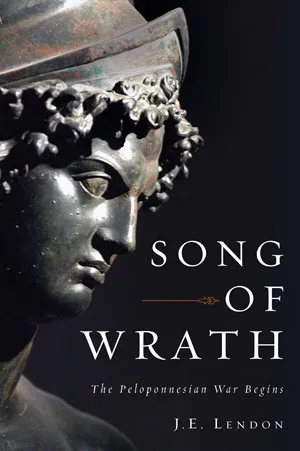
Song of Wrath
J. E. Lendon Song of Wrath: The Peloponnesian War Begins Basic Books 566 pages, 9 1/4 x 6 1/8 inches ISBN 978 0465015061
Available here →January 5, 2011
20110105-lendon-john-on-song-wrath-peloponnesian-war-begins-3
A close-up
The rest of this thread

J. E. Lendon
J. E. Lendon had a very curious upbringing””a Canadian, he was born in Lebanon and grew up in Japan””the memory of which he has tried to obliterate with a quite conventional academic career: he got his B.A. and Ph.D. from Yale, began teaching at MIT, and is now a Professor of History at The University of Virginia. He is the author of Empire of Honour: The Art of Government in the Roman World, Soldiers and Ghosts: A History of Battle in Classical Antiquity, and Song of Wrath: The Peloponnesian War Begins, featured in his Rorotoko interview. All of which is to show, in different ways, how futile his attempts have been to escape his exotic childhood.
Pull this thread
Athens and Sparta fought over rank, not advantage, and anger rather than calculation decided their strategy.
Know something the rest of us don't?
Most threads on Rorotoko begin with our invitation. Any thread can begin with a proposal: you write it with the same prompts every thread answers, and we review it.
Propose a thread →