
Leigh Eric Schmidt
Heaven’s Bride
If a reader were just dipping into the book, I hope that he or she might first browse the fourth chapter.
Against all odds, Craddock went about her work as a marital advisor and sex expert. She recorded notes on those she counseled, and these cases offer a startlingly frank and often painful look into the distress of her clients. Here is an example:
Eunice Parsons, a young nurse newly engaged in the summer of 1902, was worried about her fiancé, a piano-tuner, and had sought out Craddock for a lesson on married sexual relations. The couple had recently had “some frank talks,” and it turned out her betrothed, “a very pure-minded man,” was of the opinion that “people should have intercourse only for childbearing.” Parsons, taken aback, objected, “Suppose I don’t want any children; what then? Are we never to have intercourse?” As their discussion turned into a quarrel, her intended life-partner reproached her for being too passionate, and now she wondered if their apparent sexual incompatibility made it necessary for them to call off the wedding.
“I have made up my mind never to marry any man until he can look at the sex relation as a pure act and a sacred act,” Eunice vowed. Her would-be husband, however prudish he sounded, held the stronger hand in this dispute:
Most marital advice literature of the period, religious or not, refused to disjoin the pleasure of sex from the purpose of procreation and would have seen this particular stand-off as a worrying reversal of the usual relation of male desire and female modesty.
Parsons, fortified by Craddock’s teachings, nonetheless pressed her fiancé to reconsider his views and even convinced him to go in for a lesson himself.
Meeting with Craddock could not have been comfortable for the young man, a resolute virgin. For her pedagogy to be effective, Craddock thought it essential to explore the sexual history of her clients with a battery of diagnostic questions, including blunt inquiries about masturbation (yes, he had done that “to some extent when a boy”) and erotic dreams (yes, he had experienced a few).The piano-tuner tried to shift the tenor of the exchange through religious argument and scriptural citation:
“Quoted the Bible very earnestly,” Craddock wrote in her case notes, “about there being a war between the spirit and the flesh, to prove his contention that coition should take place only for child-bearing; say once every few years; . . . marriage was intended for the replenishment of the earth."
Unfortunately for him, Craddock wanted nothing more than to have their sex-talk turn spiritual, and soon she was explaining how in her understanding of the divine “God was feminine as well as masculine.” “I told him to think of his wife’s yoni as containing a chapel, into which he was to enter to worship—not worship the woman, but worship God,” Craddock instructed.
That lesson left him red-faced; he kept sputtering “his one idea of no coition except for child-bearing” and even insisted that his fiancée’s physical affections were supposed to be purely maternal in expression. Eunice need only dote on their prospective children, not satisfy (let alone incite) his sexual desires. “Well, well,” Craddock concluded, “if he doesn’t manage to rid himself of his idée fixe, he’ll find himself minus his sweetheart before long.”
Only at the insistence of his betrothed did the piano-tuner return for three more lessons.
He bristled at his fiancée’s newly acquired “independence of thought and action” in pushing him into this disagreeable situation, but criticizing a woman for “thinking for herself” was a non-starter with Craddock who greeted this male presumption only with barbs. Forced quickly into retreat on that point, he found himself losing ground on the main argument as well, finally acknowledging that sex for non-procreative purposes could be “pure and holy and perhaps ˜normal’ after all.”
By the close of the fourth session Craddock had gone a long way toward saving the engagement. If the piano-tuner remained wary of Eunice’s alliance with Ida, he at least had begun displaying a new appreciation for his lover’s sexual appetites and was ready to reconsider his own religious asceticism.
The advent of a secular sex revolution would render the spiritual sex revolution of nineteenth-century reformers like Craddock an increasingly bygone inheritance. “No Gods, No Masters” had been Margaret Sanger’s slogan for the Woman Rebel, and a substantial portion of the twentieth-century movement for sexual emancipation would march forward under such secular banners.
In 1979, when one of Craddock’s long suppressed pamphlets was finally republished, the reviewer for the New York Times tellingly remarked: “If one excised from Ida C. Craddock’s widely banned ˜Right Marital Living’ its pious obeisance to religion, the plain and mostly accurate talk about orgasm and the 'marital embrace’ would fit easily into a contemporary sex manual.”
Craddock’s cultural world—one in which metaphysical speculators and spiritual drifters were in the front ranks on sex-reform and civil-liberty causes—now sounded unimaginably foreign. If Craddock were to tally with the post-Kinsey, Masters and Johnson era of scientific sexology, her religion would need to be pared away.Not that sex had been successfully secularized by 1979.
This was the very year, after all, in which Jerry Falwell founded the Moral Majority, appearing, to the political left, poised to become the new Anthony Comstock. (And if not Falwell, then Donald Wildmon, who had two years earlier founded the National Federation for Decency, with its strong anti-obscenity agenda.)
With the rise of the Moral Majority and allied organizations, secular liberals were hard-pressed to envisage any form of religious piety as the handmaiden of sexual emancipation.
Strict constructions of church-state separation and personal privacy—“Get Your Bible Off My Body” and “Focus on Your Own Damn Family”—seemed, once again, imperative for the protection of a liberal civil society.In appealing to both secular principle and religious vision, the social reformers who had championed the companionate equality of marriage partners, the importance of female passion and sexual pleasure, the liberalization of divorce laws, and the rights of reproductive control, had now become ghostly anomalies. But Craddock and other “disreputables” had much to say about the joined privacy of religion and sex.
Editor: Erind Pajo
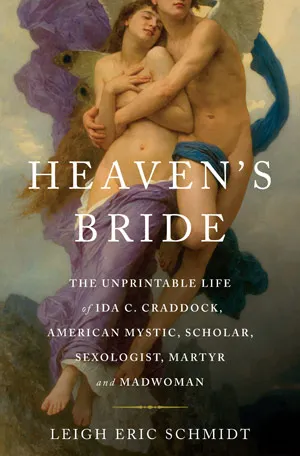
Heaven’s Bride
Leigh Eric Schmidt Heaven’s Bride: The Unprintable Life of Ida C. Craddock, American Mystic, Scholar, Sexologist, Martyr, and Madwoman Basic Books350 pages, 9 x 6 inches ISBN 978 0465002986
Available here →January 17, 2011
20110117-schmidt-leigh-on-unprintable-ida-craddock-mystic-scholar-sexologis-3
A close-up
The rest of this thread

Jonathan Beasley
Leigh Eric Schmidt
Leigh Eric Schmidt became the Charles Warren Professor of American Religious History at Harvard University in 2009. Before that, he was the Agate Brown and George L. Collord Professor of Religion at Princeton University, where he had taught since 1995. Besides Heaven’s Bride, featured in his Rorotoko interview, Schmidt is the author of Hearing Things: Religion, Illusion, and the American Enlightenment (2000), which won the American Academy of Religion Award for Excellence in Historical Studies and the John Hope Franklin Prize of the American Studies Association, Restless Souls: The Making of American Spirituality (2005), Consumer Rites: The Buying and Selling of American Holidays (1995), and other writing.
Pull this thread
The nineteenth-century sexual revolution was fought in sacred terms, and that is what made sex a private matter.
Know something the rest of us don't?
Most threads on Rorotoko begin with our invitation. Any thread can begin with a proposal: you write it with the same prompts every thread answers, and we review it.
Propose a thread →