
Paul N. Edwards
A Vast Machine
Here’s something fascinating about meteorology, from Chapter 10: most of the data in a modern weather forecast aren’t collected from instruments. Instead, they’re created by a computer simulation of the atmosphere.
As new data come in from ground stations, satellites, and other platforms, software known as the “data assimilation system” compares them with its previous forecast for the current period. Where it finds discrepancies, the data assimilation system adjusts the forecast accordingly—but not always in favor of the “real” data from instruments. When incoming data are inconsistent with the forecast, it’s sometimes the case that the problem isn’t the computer simulation, but errors in the instruments, the reporting system, or the interpretation of signals.
As one meteorologist put it in 1988, a modern data assimilation system “can be viewed as a unique and independent observing system that can generate information at a scale finer than that of the conventional observing system.” In other words—to exaggerate only slightly—simulated data are better than real data. The tremendous success of data assimilation systems in weather forecasting has a corollary for climate science, worked out over the last two decades. It might just be possible, some scientists think, to take the world’s entire collection of weather data and run it through a modern data assimilation system and forecast model to produce a kind of movie of global weather from about 1900 on.
Called “reanalysis,” this process (the subject of Chapter 12) has already produced some very important climate data sets for the past 40-50 years. So far, they’re less accurate than our historical climate data—but they’re also far more detailed, because of the information the models can actually generate.
Computer-based information infrastructures continue to evolve, with strong effects on climate science and politics.
Once upon a time, climate models and data were held and interpreted only by a tiny elite. But rapidly spreading ideals of transparency now combine with technological capabilities to permit or even require the open sharing of both. The Climate Code Foundation advocates the publication of climate model code, and many laboratories already do that. Most major climate data centers now make basic data readily available online (though using and interpreting such data still requires considerable expertise).
Meanwhile, anyone with a head for math can master powerful statistical analysis tools, and knowledge of computer programming is widespread. These capabilities have facilitated the rise of blogs such as Climate Audit, which purports to independently evaluate climate data.
These projects hold great potential for scientific benefits—but they also have enormous drawbacks. By moving technical discussions of climate knowledge into a public universe beyond the boundaries of accredited science, they make it exponentially harder for journalists and the general public to distinguish between genuine experts, mere pretenders, and disinformation agents.
Anyone who still doubts that denialism about climate change is deliberately manufactured by vested interests should read Naomi Oreskes’ Merchants of Doubt and James Hoggan’s Climate Cover-Up.A Vast Machine is mainly about the history of climate knowledge. But on another level, the book concerns an even deeper problem, namely how we know anything about any complex, large-scale phenomenon.
Not so long ago, scientific ideology held data as the ultimate test of truth and theory as the ultimate source of knowledge. Models and simulations were seen as mere heuristics, poor imitations of reality useful mainly to spark ideas about how to improve theory and generate more data.
In the last three decades things have changed. In today’s sciences, many kinds of data are understood to be imperfect and in need of adjustment through modeling. Meanwhile, simulation has become a principal technique of investigation—not merely a supplement to theory, but an embodiment of complexities that can’t be fully reduced to well-understood principles.
Think of anything big you care about: earthquakes, rain forests, the global economy, world population, the ozone hole. Today you’ll find computer simulations and data modeling at the heart of the science that studies it. Climate science led the way to this colossal shift in the scientific method, whose ramifications we are still discovering.
The ubiquity of simulation and data modeling in modern science—and further afield, in financial models, polling, economic forecasts, Google searches, and the myriad other places models and data touch each other in contemporary life—requires us to seek a more realistic and sophisticated picture of how knowledge is made, and what it means to say that we know something.
Editor: Erind Pajo
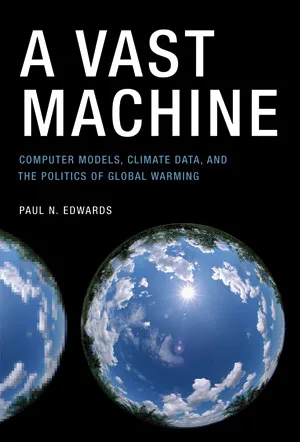
A Vast Machine
Paul N. Edwards A Vast Machine: Computer Models, Climate Data, and the Politics of Global Warming MIT Press 528 pages, 9 x 6¼ inches ISBN 978 0262013925
Available here →March 7, 2011
20110307-edwards-paul-on-computer-models-climate-data-politics-global-warmi-3
A close-up
The rest of this thread

Paul N. Edwards
Paul N. Edwards is Professor of Information and History at the University of Michigan. He writes and teaches about the history, politics, and culture of information infrastructures. In addition to A Vast Machine, featured in his Rorotoko interview, Edwards is the author of The Closed World: Computers and the Politics of Discourse in Cold War America (MIT Press, 1996) and co-editor (with Clark Miller) of Changing the Atmosphere: Expert Knowledge and Environmental Governance (2001). He also maintains a personal website and one with additional information and downloads related to A Vast Machine.
Pull this thread
There is no such thing as raw global climate data.
Know something the rest of us don't?
Most threads on Rorotoko begin with our invitation. Any thread can begin with a proposal: you write it with the same prompts every thread answers, and we review it.
Propose a thread →