
Caroline Rody
The Interethnic Imagination
I would hope that a browsing reader would open the book to its first pages—which I intended as a lively, reader-friendly introduction. I start with a roster of surprising characters from contemporary Asian American fiction, unfamiliar kinds of characters who, because of their genetic mixture, or by means of their virtuso performances of cultural hybridity, embody contemporary fiction’s urge towards imaginative engagement with the difference of others.
The three novels given most extended attention in the book all close with scenes that feature a family embrace around a mixed-race child. Such children, positioned to leave the stamp of their faces on the books’ endings, look to me like a vision of the emerging American readership. I mean to point to them, too, as emblems of an increasingly open-ended American literature.
Several adult characters from these novels, by mastering and mixing multiple ethnic languages, kinds of music, cuisines, rituals, or forms of political speech become—for other characters and for the reader—spectacles of charged, riddling, potentially liberating multiethnic fusion.Novelistic characters are not the only sites of the interethnic turn that this preface investigates, but I use them here as an introduction to the energetic invention a reader will find in the new interethnic literature.
The preface goes on to discuss the way that the English language itself in contemporary American fiction is dramatically swelling, crossbred with myriad immigrant languages that daily enrich it.In Jiro Adachi’s The Island of Bicycle Dancers, a young Korean Japanese immigrant in lower Manhattan tries to pick up the local talk, but finds herself surrounded by “too many different kinds of English”: “Korean English” from her relatives, “American English” from a friend, “Chinese English from the high school kids on the 7 train, Spanish English everywhere, Russian English and Polish English near Lucky Market; black English all over, even from white people and some Asians—everyone trying to act black.”
Not simply the hegemonic language of a superpower, English here is a dynamic medium of cultural interchange, being reworked on the tongues of multitudes of its new possessors. The novels of the interethnic turn prefer their English different, mixed, new; they affirm linguistic multiplicity and fusion as in themselves good, finding uniform speech the enemy of vitality, beauty, and hope. They deliver a kind of English with its ears open to the talking world.
These unprecedented kinds of characters and the fresh language they bring to the American novel constitute just the first layer of the book’s investigations of a literature in transformation.Besides calling readers’ and scholars’ attention to a paradigm shift in contemporary Asian American and other ethnic texts, I also hope this book will help spread appreciation for the imaginative work of contemporary fiction. In the midst of enormous global changes, our writers are out there ahead of most thinkers, it seems to me, in imagining the consequences of the prodigious enmeshment of peoples happening all around us.
They stretch the capacity of inherited literary forms (the novel, the short story) in remarkable ways to accommodate multiplicity and complexity of vision.Not all of these stagings of encounter render up happiness, by any means. Fraught histories of racialization and intergroup relations haunt many of them, miring their plots of affiliation in uncertainty, foreboding, even grief. Lee’s Native Speaker, for example, oscillates between visions of the multicultural crowd as resplendent, global assemblage—in lyrical, Whitmanesque invocations of a colorful New York City sublime—and terrifying visions of the crowd as deadly force, one with potentially tragic consequences for the individual and for the home virtues of family, love, and loyalty.
But whether depicting dire or fruitful kinds of interethnic encounters, these texts move us with the seemingly limitless capacity of creative literature to reinterpret and to enrich our experience of the changing world.
Editor: Erind Pajo
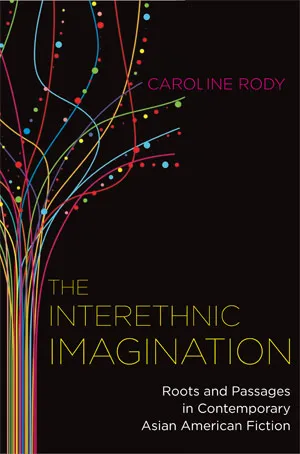
The Interethnic Imagination
Caroline Rody The Interethnic Imagination: Roots and Passages in Contemporary Asian American Fiction Oxford University Press216 pages, 9¼ x 6¼ inches ISBN 978 0195377361
Available here →March 14, 2011
20110314-rody-caroline-interethnic-imagination-roots-contemporary-asian-ame-3
A close-up
The rest of this thread

Caroline Rody
Caroline Rody is Associate Professor of English at the University of Virginia. The Interethnic Imagination, featured in her Rorotoko interview, is her second book with Oxford University Press; the first was The Daughter's Return: African-American and Caribbean Women's Fictions of History (2001). She is currently at work on a study of the reimagination of the past in contemporary Jewish American fiction.
Pull this thread
Ethnic American literature has become interethnic literature, founded on multiethnic interconnection as its premise.
Know something the rest of us don't?
Most threads on Rorotoko begin with our invitation. Any thread can begin with a proposal: you write it with the same prompts every thread answers, and we review it.
Propose a thread →