
S. Jonathan Wiesen
Creating the Nazi Marketplace
Your browsing reader might want to start with Chapter 4, which is a case study of a consumer research organization founded in the Nazi years.The Society for Consumer Research (GfK) began in 1934 in Nuremberg, and today it is Germany’s largest market research organization—in fact, one of the largest in the world. The GfK’s early years under Nazism provide an illuminating look into the meaning of consumption and the practice of marketing under Hitler.The GfK’s advisory board included executives and owners from a variety of German companies, which commissioned dozens of reports on consumer attitudes about products like cigarettes, automobiles, and perfumes.Until the end of the war, members of the GfK met to discuss effective marketing techniques, the links between gender and consumption, and the relationship between consumers and the Volk. The GfK defended brand names against cheap imitation products, probed the nature of individual desire, and explored the merits of applied psychology in their research. And they read through American department store catalogues—like Sears and Montgomery Ward—to discover which time saving devices might be desirable in Germany.Perhaps the most revealing aspect is the extent to which the GfK’s practices resembled the work of market research in other countries—like the United States. Even under the watchful eye of a police state, GfK associates went door-to-door, interviewing people about what products and ad campaigns they liked or hated. They entered private homes, complimented the housewife for her decorating taste, and then proceeded to talk about panty hose, hair sprays, cars, and foods. They were perhaps surprised to hear consumers on occasion complaining openly about both the intrusiveness of advertisements and attempts by the Nazi state to regulate consumption.The mix of support for the regime, enthusiasm for name brands, optimism about future abundance, and anger about wartime regulations revealed itself in full force in the GfK reports.Creating the Nazi Marketplace contributes to the scholarly literature on the Third Reich by bringing into the foreground two broad themes—mass consumption and business complicity—that have never been systematically linked. And it ultimately reveals how both social consensus and state brutality in Nazi Germany relied on the daily ritual of consumption.The book also speaks to other intersecting themes currently of interest to German historians and generalists: the behavior and study of consumers in fascist and non-fascist settings, the importance of “everyday” life in Nazi Germany, and international contacts (especially between Germany and the United States) during the 1930s and 1940s.
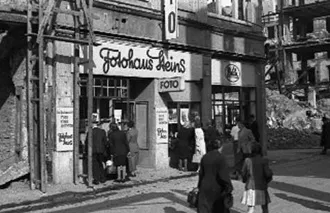
Window shopping in war-torn Cologne. (Photo Erich Behnke; courtesy of Landesarchiv Nordrhein-Westfalen)
Editor: Erind Pajo
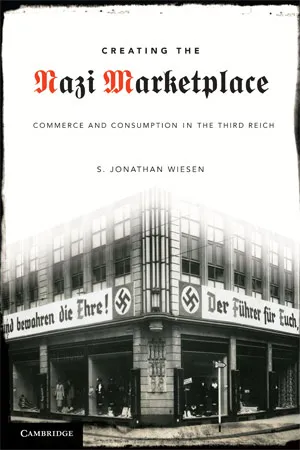
Creating the Nazi Marketplace
S. Jonathan Wiesen Creating the Nazi Marketplace: Commerce and Consumption in the Third Reich Cambridge University Press288 pages, 9 x 6 inches ISBN 978 0521762533ISBN 978 0521746366
Available here →March 21, 2011
20110321-wiesen-jonathan-on-creating-nazi-marketplace-commerce-consumption-3
A close-up
The rest of this thread

S. Jonathan Wiesen
S. Jonathan Wiesen is Associate Professor of History at Southern Illinois University Carbondale. Besides Creating the Nazi Marketplace, featured in his Rorotoko interview, he is the author of West German industry and the Challenge of the Nazi Past, 1945-1955 (2001), co-winner of the 2002 book prize from the Hagley Museum and Library and the Business History Conference, and the coeditor of Selling Modernity: Advertising in Twentieth Century Germany (2007). His work has appeared in a number of scholarly journals, including Central European History, Holocaust and Genocide Studies, and the Journal of Contemporary History.
Pull this thread
The Nazis kept the consumer marketplace running, and that semblance of normality sustained popular support and enabled the regime's crimes.
Know something the rest of us don't?
Most threads on Rorotoko begin with our invitation. Any thread can begin with a proposal: you write it with the same prompts every thread answers, and we review it.
Propose a thread →