
Kevin W. Saunders
Degradation
Given the conceptual similarity between obscene depictions and hate speech, it would seem likely that some guidance could be drawn from the analysis of obscenity that would help us more clearly understand hate speech.
The legal definition of obscenity, at least in the United States, requires that the material appeal to the prurient interest. The prurient interest goes beyond the normal interest in sex to the level of the shameful or morbid. I argued, in my first book, that the distinction is between sex as a part of human relationships and sex divorced from humanity.
Where there is this dehumanized emphasis, material can be considered obscene.
Degradation below the level of humanity, then, would seem key in the legal definition of obscenity. That part of the definition can be adapted with ease to hate speech, by requiring an intent to appeal to a degraded or dehumanized view of its target.
It can help to distinguish between the self-labeling and other-labeling uses of the same word. A word may not be objectionable, when used by a member of the group to which it refers. This is because it is unlikely to be used with any dehumanizing intent. When used by someone who is not a member of the group, the assumption of lack of intent is lacking.
But, requiring that we actually find such intent puts us on notice that we must consider the possibility that the intent is in fact lacking. This would help us distinguish between racist utterances and nonracist, although likely unwise, uses of the same word.
The other aspects of the test for obscenity, an offensiveness under community standards and the lack of serious value, could also carry over to utterances of what could potentially be seen as hate speech. While the conclusions on all these issues are likely to be very fact specific, they provide a framework for analyzing expression to determine whether it is nonoffensive or racist, sexist, or homophobic.
During the campaign that led to his presidency, Barack Obama called for a national conversation about race, a call later repeated by the Attorney General Eric Holder.If we are going to engage in that conversation, we must first have some understanding as to the proper vocabulary.
Too often, people refuse to be drawn into any conversation regarding race—out of fear that someone may take their comments as racist. For most of us, that is one of the worst accusations we could face. So we choose to remain silent.
The possibility of this accusation and its resulting stifling of any conversation stems from the fact that identification of speech as racist, sexist, or homophobic seems to occur at the gut level.
Admittedly, in many instances, the gut feeling will be correct. But, there are clearly instances in which what is perceived as hate speech was really not intended as such.
My hope is that this book’s examination of degradation will help us improve our conversation.
Editor: Erind Pajo
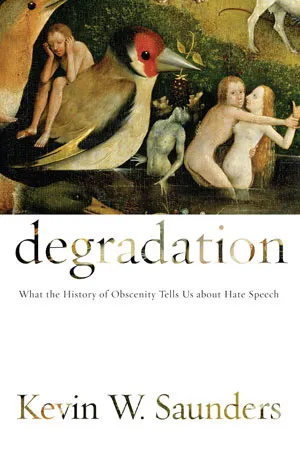
Degradation
Kevin W. Saunders Degradation: What the History of Obscenity Tells Us about Hate Speech New York University Press256 pages ISBN 978 0814741443ISBN 978 0814741450
Available here →March 28, 2011
20110328-saunders-kevin-on-degradation-history-obscenity-tells-hate-speech-3
A close-up
The rest of this thread

MSU College of Law
Kevin W. Saunders
Kevin W. Saunders holds the Charles Clarke Chair in Constitutional Law at Michigan State University. Besides Degradation, featured in his Rorotoko interview, he is the author of Violence as Obscenity, Saving Our Children from the First Amendment, as well as dozens of law review articles on issues involving free expression. Saunders received a Ph.D. in philosophy from the University of Miami and a J.D. from the University of Michigan.
Pull this thread
Obscenity law was never about sex but about degradation, and hate speech is the same act with a narrower target.
Know something the rest of us don't?
Most threads on Rorotoko begin with our invitation. Any thread can begin with a proposal: you write it with the same prompts every thread answers, and we review it.
Propose a thread →