
Djelal Kadir
Memos from the Besieged City
The brief Epilogue of Memos from the Besieged City, like many aspects of this book, pivots on its two epigraphs. The first is from Walt Whitman’s ambiguously democratic and imperialist “Democratic Vistas” (1871); the second is from Theodor Adorno’s 1967 essay “Commitment,” a palinode to his 1949 statement on the inevitably barbaric nature of poetry after the Holocaust.
The passage cited from the latter essay reads, “Perennial suffering has as much right to expression as a tortured man has to scream: hence it may have been wrong to say that after Auschwitz you could no longer write poems.” Torture is an integral part of terror and our own age is self-defined as an age of terrorism. Poetry in the broad sense of literature–its composition and reading–may well be the most efficacious antidote to terror, whether the terror practiced by states or by non-state agents. Human history complicates such a desired role for poetry: While this desideratum has often been corroborated, poetry’s civilizing role has also been disconfirmed, with more than one torturer also having responded to the muses’ call.
The lifelines traced by Memos from the Besieged City are literary lines, more accurately, lines of literacy, or the ability to read the historical past and decipher the historical present. As re-traced quickly in the Epilogue, this book is a retelling of modes of literacy and the dangers to those throughout history who have taught us to read and write otherwise. This, at the end of the day, is the nature of true literacy—that is, critical discernment, rather than prepackaged recitation.
The “Minute on Method” recapitulates in this Epilogue a reminder of how we develop and cultivate the wherewithal to enter into and become part of the ongoing conversation–a nexus with and an articulateness about our inheritance from the past and our legacy to posterity, without which the nihilism of inarticulateness finds us at the edge of the abyss of barbarity and its familiar terrors.
Memos from the Besieged City should be read as an ethical intervention in a larger conversation—larger than the strictures particular academic disciplines and their argots have imposed on our institutional and individual horizons. In this sense, it is a performative participation in what we now call “world literature,” that is, an engagement with the worlds of literature that define our world and embody the literary corpus as worldly aggregate of our cultural histories.
In the face of abhorrent political and social realities, current critical discourses may have begun to emerge from the arcane modes of highly sophisticated and self-reflective soliloquy. While we may be central to our historical and cultural consciousness, this book argues that consciousness has to be alert to more than itself.
Memos from the Besieged City is intended to be part of this ethical turn, one in which we read historical and textual realities closely and, at the same time, see the larger implications of what we perceive.
Close reading, if properly critical, is not oblivious to the more distant resonance and worldly repercussions of our acts of perception and discernment. Vigilance to this aspect of our endeavors is tantamount to an ethics of reading and writing. And Memos from the Besieged City should be read in the spirit of this alertness.
Editor: Erind Pajo
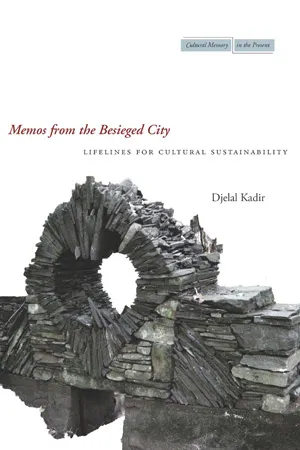
Memos from the Besieged City
Djelal Kadir Memos from the Besieged City: Lifelines for Cultural Sustainability Stanford University Press 304 pages, 6 x 8 3/4 inches ISBN: 978 0804770507 ISBN: 978 0804770491
Available here →April 20, 2011
20110420-kadir-djelal-memos-besieged-city-lifelines-cultural-sustainabilit-3
A close-up
The rest of this thread
Matt Proctor
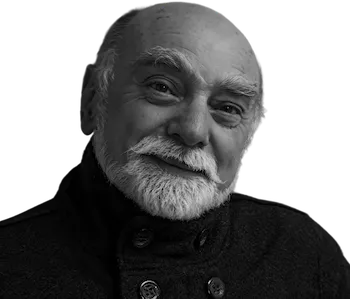
Djelal Kadir
Djelal Kadir is the Edwin Erle Sparks Professor of Comparative Literature at Pennsylvania State University. Besides Memos from the Besieged City, featured in his Rorotoko interview, he has authored, among other books, Questing Fictions (1986), Columbus and the Ends of the Earth (1992), The Other Writing (1993), and co-edited the Longman Anthology of World Literature (2003; 2009) and the Comparative History of Latin American Literary Cultures (2004). Djelal Kadir is the Founding President of the International American Studies Association, a member of the Advisory Board of the American Comparative Literature Association, a Fellow and Board member of the Stockholm Collegium of World Literary History, of Synapsis: The European School of Comparative Studies, and of the Institute for World Literature.
Pull this thread
Literacy is critical discernment, not recitation, and criticism that stays inside disciplinary strictures fails the ethical obligation of reading.
Know something the rest of us don't?
Most threads on Rorotoko begin with our invitation. Any thread can begin with a proposal: you write it with the same prompts every thread answers, and we review it.
Propose a thread →