A browser, who simply starts at the beginning and reads through the initial discussion of American exceptionalism, will see how our most familiar political practices and beliefs include a distinctive set of commitments that require a political theological explanation.American exceptionalism is completely impenetrable to liberal political theory, which sees it only as an unjust claim of privilege. That approach fails to understand the stakes, which are about identity, existence, and decision—not about norms.
If American exceptionalism remains a vibrant practice and set of beliefs, we must turn from traditional political theory to a political theology.For Americans, law is only in part about justice. More importantly, law expresses the will of the popular sovereign.We find in law an expression of our national identity as a self-governing community that has a singular character, to be maintained across generations.This is the reason we instinctively resist international law—except perhaps when it limits itself to the regulation of transnational markets and forms of communication. We resist human rights law, even when the standards are much the same as our own civil rights law.
We will not subordinate the Constitution to a global order of rights. There is, for this reason, virtually no political support for international courts, including the new International Criminal Court.Schmitt talked about the sovereign decision for the exception. We talk about American exceptionalism. These two forms of exception are deeply related. To understand that relationship we have to redirect political theology to a practice of popular sovereignty.
Political theory at the turn of the millennium was a dying field, of interest to only a dwindling group of academics. The innovations in the field were European imports that largely reflected the complicated history of post-Marxist thought there. These innovations, for the most part, made no connection with the American political imagination.We need a political theory that takes seriously our own political practices and beliefs. We must talk less about what politics should be, and more about who we are.
Of course, we are free to criticize what we find: we are not bound to our political practices as if to nature itself. But if our criticisms are going to have any purchase on the larger public, we must first understand the set of meanings that have informed our political practices for a very long time.
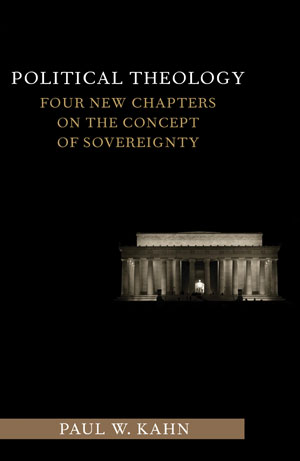
Political Theology promises a rebirth of political theory as an inquiry into the nature of human freedom as it has been realized in a distinctive set of practices and beliefs.I have sought to lay a foundation, which I hope will be built upon by broad and deep inquiries into the American social imaginary as it responds to its own creation: a practice of popular sovereignty. Those inquiries should span law, history, and popular culture. In each of these domains of the imagination, we are practicing our own freedom.